Seed plants: gymnosperms and angiosperms
Unit 3 · Evolution and Diversity of Organisms
The seed habit, the gymnosperms (cycads, conifers, Gnetum), flowering plants (angiosperms), the flower, double fertilisation, and monocots compared with dicots.
The seed habit
In seed plants (spermatophytes) the sporophyte is the large plant, and the gametophytes are tiny and live inside the sporophyte, nourished by it. Four new features freed seed plants from the need for water in reproduction:
- Heterospory. Two kinds of spores are made: microspores (become male gametophytes, the pollen grains) and megaspores (become female gametophytes).
- Ovules. The megaspore is kept inside the ovule (a megasporangium wrapped in tissue called integuments). After fertilisation the ovule becomes a seed.
- Pollen. The male gametophyte is a pollen grain with a tough wall of sporopollenin, carried by wind or animals (pollination). It grows a pollen tube that delivers the sperm to the egg, so water is not needed for fertilisation.
- Seeds. A seed contains a young sporophyte (embryo), food (stored in the endosperm or cotyledons) and a protective seed coat. It can stay dormant for a long time and is dispersed far from the parent.
Gymnosperms ("naked seeds")
Gymnosperms bear their ovules and seeds exposed on the scales of cones (they are not enclosed in an ovary). They have no flowers and no fruits. They have woody stems with tracheids as the only water-conducting cells, and no vessels. Most are evergreen trees and shrubs, and many are adapted to cold or dry conditions with needle-like leaves with a thick cuticle and sunken stomata. They are wind-pollinated.
| Group | Examples | Features |
|---|---|---|
| Cycadophyta (cycads) | Cycas (the cycad found in dry forests and gardens of Sri Lanka) | Palm-like, with large pinnate leaves; male and female cones on separate plants; swimming sperm in some |
| Ginkgophyta | Ginkgo biloba | One living species; fan-shaped leaves; fleshy seed |
| Coniferophyta (conifers) | Pinus (pines, which are planted in the hill country of Sri Lanka), Araucaria, Cupressus | The largest group; needle leaves; male and female cones on the same tree; resin ducts |
| Gnetophyta | Gnetum (a climber of Sri Lankan rainforests), Ephedra | Have vessels, like angiosperms |
Life cycle of a pine in brief. A mature pine (sporophyte) has small male cones (microsporangia produce pollen by meiosis) and larger female cones (two ovules on each scale; a megaspore mother cell in each ovule divides by meiosis, and one megaspore forms the female gametophyte with archegonia and eggs). Pollen is carried by wind to the ovule, grows a pollen tube slowly (about a year), and fertilisation produces a zygote. The zygote becomes an embryo, and the ovule becomes a winged seed. A cone needs about two years to ripen.
Importance: timber and paper pulp (pines), resin and turpentine, ornamental plants, and the food and starch (sago) from some cycads.
Angiosperms (flowering plants)
Angiosperms (phylum Anthophyta or Angiospermae) are the largest and most successful group of plants, with over 300 000 species. They dominate most terrestrial habitats because of:
- Flowers, the reproductive organs, which attract animal pollinators.
- Carpels that enclose the ovules in an ovary; the ovary wall becomes the fruit, which protects the seeds and helps to disperse them.
- Vessels and fibres in the xylem (more efficient water conduction and support than tracheids alone) and sieve tube elements with companion cells in the phloem.
- Double fertilisation and a much-reduced gametophyte, which means a short life cycle.
- Coevolution with pollinators and seed dispersers.
The flower
A typical flower has four whorls on the receptacle:
- Sepals (the calyx) protect the bud.
- Petals (the corolla) attract pollinators.
- Stamens (the androecium; the male parts): the anther contains microsporangia that make pollen, on a filament.
- Carpels (the gynoecium; the female parts): a stigma (receives pollen), a style and an ovary with one or more ovules.
The life cycle of an angiosperm
- In the anther each microspore mother cell divides by meiosis to give four haploid microspores. Each becomes a pollen grain (the male gametophyte) with two cells: a tube cell and a generative cell, which later divides into two sperm nuclei.
- In the ovule a megaspore mother cell divides by meiosis and one of the four megaspores survives. It divides three times by mitosis to give an embryo sac (the female gametophyte) with seven cells and eight nuclei, including the egg cell and a large central cell with two polar nuclei.
- Pollination places pollen on the stigma. The pollen tube grows down the style into the ovule and releases the two sperm nuclei.
- Double fertilisation: one sperm fuses with the egg to form the diploid (2n) zygote, and the other fuses with the two polar nuclei to form the triploid (3n) endosperm, the food store.
- The zygote develops into the embryo, the ovule becomes the seed and the ovary becomes the fruit.
Exam tip: Be able to state the ploidy at each stage: microspore mother cell 2n; microspores n; pollen grain n; egg n; polar nuclei n and n; zygote 2n; endosperm 3n; seed coat 2n (from the integuments of the parent).
Monocots and dicots
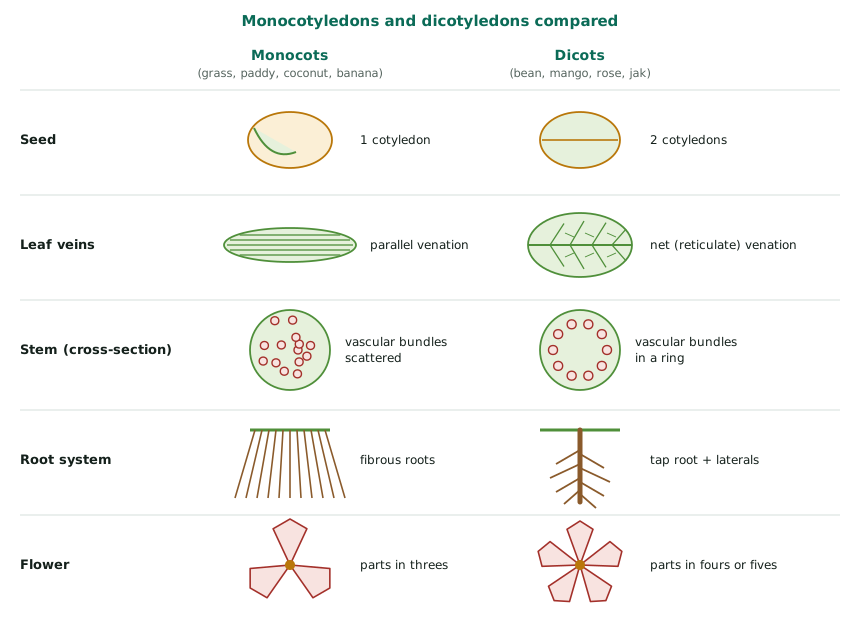
| Feature | Monocotyledons | Dicotyledons |
|---|---|---|
| Cotyledons in the seed | One | Two |
| Leaf venation | Parallel | Net (reticulate) |
| Vascular bundles in the stem | Scattered | In a ring |
| Cambium (secondary growth) | Absent in most | Present in woody types |
| Root system | Fibrous (adventitious roots) | Tap root with laterals |
| Floral parts | In threes (or multiples) | In fours or fives (or multiples) |
| Pollen grain | One pore or furrow | Three pores or furrows |
| Examples | Rice, maize, coconut, banana, orchids, grasses | Bean, mango, rose, jak, teak, cinnamon |
Importance of angiosperms: nearly all of our food (cereals such as rice, pulses, fruits, vegetables, oils), fibres (cotton), timber (teak, mahogany, jak), medicines (e.g. Adhatoda, Catharanthus roseus), spices (cinnamon, pepper, cardamom, cloves) and the major plantation crops of Sri Lanka (tea, rubber, coconut).