The scientific method in biology
Unit 1 · Introduction to Biology
Observation, hypothesis, prediction, controlled experiment, analysis and conclusion; variables, controls, replication, sampling, and how theories differ from hypotheses.
How biologists find answers
Biology is an evidence-based science. Biologists do not simply decide what is true: they ask questions that can be tested, collect data, and let the data decide. The usual pattern of investigation is called the scientific method. It is not a fixed recipe: scientists move back and forth between the steps, and some discoveries begin by accident, but the logic is the same.
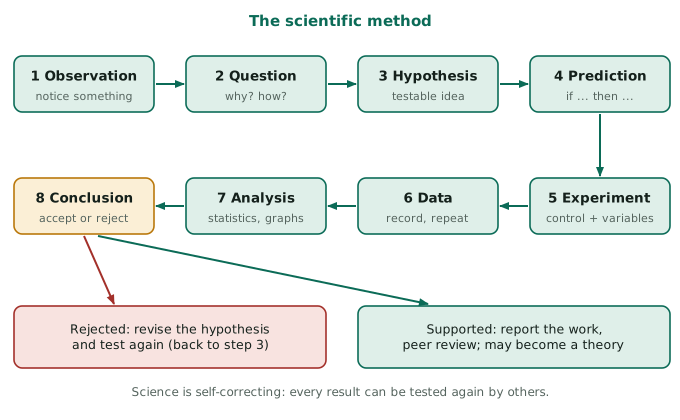
The steps
- Observation. Something is noticed, by the senses or by instruments. For example: pond plants kept in the shade grow more slowly.
- Question. A specific, answerable question: does light intensity affect the growth rate of Hydrilla?
- Hypothesis. A tentative, testable explanation: a higher light intensity increases the rate of photosynthesis and so the growth of Hydrilla. A good hypothesis is testable and falsifiable: it must be possible to show it is wrong. "Life was designed" or "plants like light" cannot be tested in this way.
- Prediction. A logical consequence in the form "if ... then ...": if the hypothesis is correct, then plants nearer a lamp will produce more oxygen bubbles per minute.
- Experiment. A planned test of the prediction (see below), or an observational study where experiments are not possible (for example in ecology or evolution).
- Data collection. Careful, repeated measurements, recorded in tables.
- Analysis. Calculations, graphs and statistical tests to decide whether any difference is larger than expected by chance.
- Conclusion. The data either support the hypothesis or lead us to reject it. If it is rejected, the hypothesis is revised and tested again. A supported hypothesis is never "proved" beyond all doubt; it simply has not yet been disproved.
Finally the work is reported (journal, conference) and peer reviewed, so that other scientists can check it and repeat it. Results that cannot be repeated are not accepted.
Designing a controlled experiment
Example: Investigating the effect of light intensity on the rate of photosynthesis of Hydrilla by counting oxygen bubbles.
- The independent variable is the one you deliberately change: distance of the lamp (light intensity).
- The dependent variable is the one you measure: number of bubbles per minute.
- Controlled (constant) variables are everything else that could affect the result and must be kept the same: temperature (use a water bath or heat filter), $\text{CO}_2$ concentration (same amount of sodium hydrogencarbonate), plant species and size, time of counting.
- A control is a set-up where the factor being tested is absent or standard, giving a baseline. For example, a tube with no plant, or one in darkness, to show that bubbles come from the plant using light. In drug trials, a control group receives a placebo.
- Replication: repeat the measurement several times and use several plants, then calculate the mean. This reduces the effect of random error.
- Sampling: when studying a large population, measure a random sample large enough to represent it and to avoid bias.
Errors and reliability
- Random errors cause scattered readings; repeating and averaging reduces them.
- Systematic errors (for example a wrongly calibrated instrument) shift all readings the same way; they are removed by correcting the method or equipment.
- A result is reliable if repeating gives similar values, and valid if the experiment really tests the question asked.
Hypothesis, theory and law
A hypothesis is a specific explanation to be tested. A scientific theory is a broad explanation of some aspect of nature that has been tested again and again and is supported by a large body of evidence from different fields: the cell theory, the theory of evolution by natural selection, the germ theory of disease. In everyday language "theory" means a guess, but in science it is the strongest kind of explanation. A law (such as Mendel's laws) describes a regular pattern, often as a mathematical relationship.
Famous examples
- Pasteur's swan-neck flask experiment (1860s) tested the idea that microbes arise from non-living matter (spontaneous generation). Broth in a flask with a curved neck stayed sterile because dust and microbes were trapped in the bend, but broth became cloudy once the neck was broken: microbes come from other microbes.
- Redi's experiment (1668) with meat in covered and uncovered jars showed that maggots come from eggs laid by flies, not from rotting meat.
Ethics and honesty in science
Scientists must report results honestly (never invent or select data), give credit to others, handle living organisms with care, follow safety rules and obtain approval for work with humans or animals.
Exam tip: In planning questions, name the independent, dependent and controlled variables, say how you will measure the dependent variable, describe a control and mention replication. A hypothesis is a statement; a prediction is the "if ... then ..." result you expect to see.
Deshapriya Senevirathne. B.Sc. (Hons) Biology Special, University of Peradeniya — graduated with a class pass. All the content and lessons in A/L Biology on Paadama are reviewed by Deshapriya Senevirathne, and the lessons are taught by him.