Prokaryotic and eukaryotic cells
Unit 2 · Chemical and Cellular Basis of Life
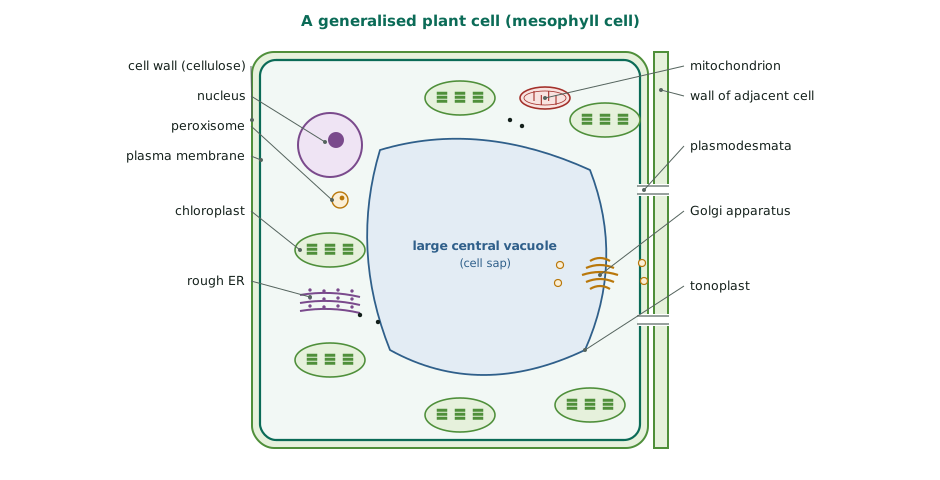
The features common to all cells and the differences between prokaryotic and eukaryotic cells (Table 2.4), with the structure of animal and plant cells.
Two types of cell
There are two types of cell: prokaryotic and eukaryotic. The domains Bacteria and Archaea are prokaryotes; all other organisms are eukaryotes.
All cells share these basic features:
- a plasma membrane that acts as a selective barrier round the cell;
- a semi-fluid, jelly-like cytosol inside the cell, in which the subcellular components are suspended;
- DNA as the hereditary material;
- ribosomes.
Prokaryotic and eukaryotic cells compared
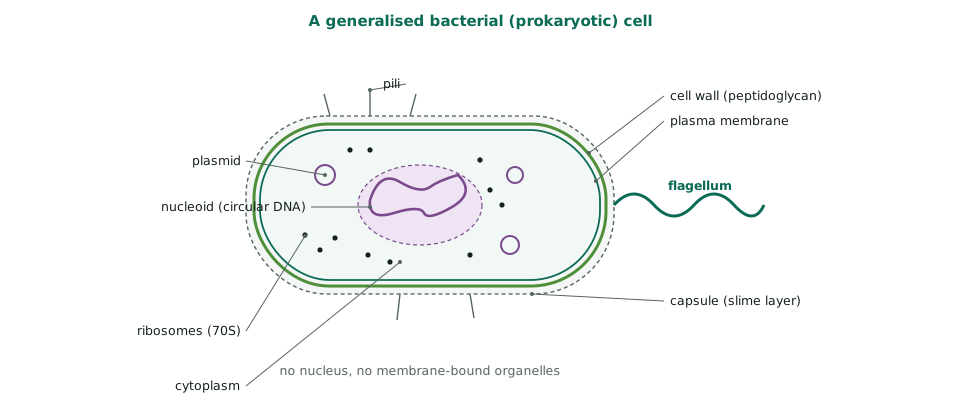
| Feature | Prokaryotic cell | Eukaryotic cell |
|---|---|---|
| Organisms | bacteria, archaebacteria | protists, fungi, plants, animals |
| Cell size | usually 0.5-5 µm in diameter | 10-100 µm in diameter |
| Form | mainly unicellular | mainly multicellular (many protists and some fungi are unicellular) |
| Evolutionary origin | 3.5 billion years ago | 1.8 billion years ago, from prokaryotes |
| Cell division | binary fission; no mitosis or meiosis | mitosis, meiosis or both |
| Genetic material | circular DNA lying free in the cytoplasm in the nucleoid region, not bound to histones | linear DNA inside the nucleus, bound to histones |
| Ribosomes | 70S (small) | 80S (large), free in the cytosol or attached to the ER; 70S in mitochondria and chloroplasts |
| Organelles | no membrane-bound organelles; few components (e.g. ribosomes). Internal membranes are rare, and if present are linked to respiration, photosynthesis or N₂ fixation | many kinds of membrane-bound organelles; nucleus, mitochondria and chloroplast have two membranes, lysosomes and vacuoles one |
| Cell wall | peptidoglycan in bacteria and cyanobacteria; polysaccharides and proteins in archaebacteria | rigid polysaccharide wall in plants (cellulose) and fungi (chitin); none in animals |
| Flagella | simple, no microtubules, extracellular (not covered by the cell surface membrane), 20 nm wide | complex, 9+2 microtubules, intracellular (covered by the membrane), 200 nm wide |
| Respiration | on infoldings of internal membranes | in mitochondria (aerobic respiration) |
| Photosynthesis | no chloroplasts; on membranes not arranged in stacks | in chloroplasts, with membranes usually stacked as lamellae or grana |
| Nitrogen fixation | some can fix nitrogen | none can |
Animal cell and plant cell
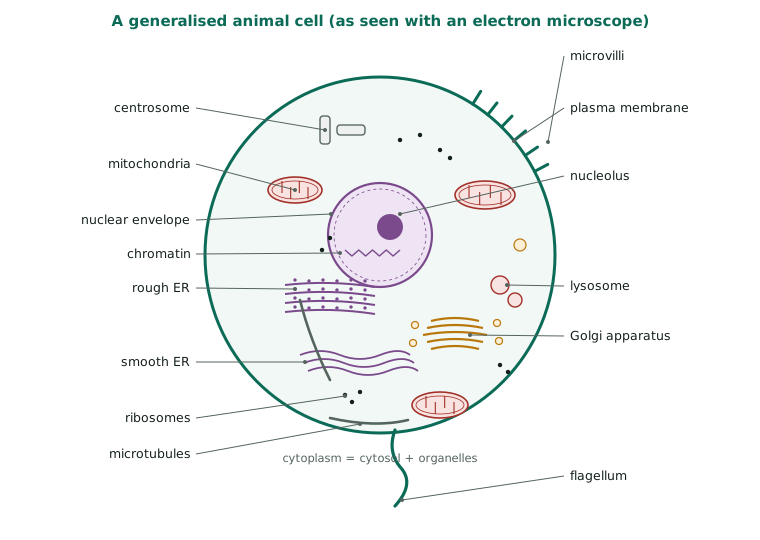
The animal cell contains: flagellum, smooth ER, rough ER, chromatin, nuclear envelope, nucleolus, lysosome, mitochondria, microtubules, microvilli, centrosome, Golgi apparatus, ribosomes and the plasma membrane.
The plant cell has most of the same parts and, in addition, a central vacuole, peroxisome, chloroplast, cell wall and plasmodesmata (connections to the next cell).
Each of these structures is described in the next lessons.
Exam tip: Tables like this are usually tested row by row. Revise: size (0.5-5 vs 10-100 µm), age (3.5 vs 1.8 billion years), division (binary fission vs mitosis/meiosis), ribosomes (70S vs 80S), flagellum (20 nm extracellular vs 200 nm intracellular 9+2) and nitrogen fixation (some prokaryotes only).
Deshapriya Senevirathne. B.Sc. (Hons) Biology Special, University of Peradeniya — graduated with a class pass. All the content and lessons in A/L Biology on Paadama are reviewed by Deshapriya Senevirathne, and the lessons are taught by him.