Structure and function of the plasma membrane
Unit 2 · Chemical and Cellular Basis of Life
The fluid-mosaic model of the plasma membrane: phospholipid bilayer, integral and peripheral proteins, cholesterol, glycoproteins and glycolipids, and the six functions.
The plasma membrane
The plasma membrane is the outermost boundary of the cytoplasm. All the membranes of a cell share the same fine structure.
The fluid-mosaic model
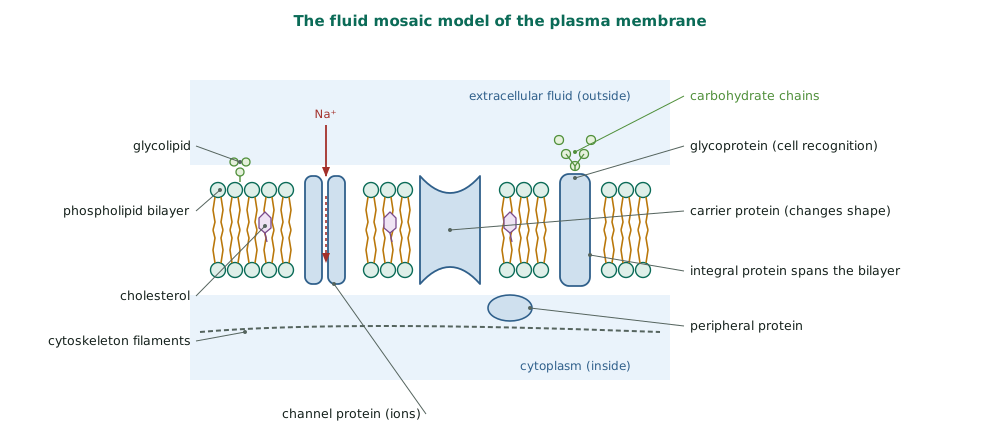
In 1972, Singer and Nicolson proposed the fluid-mosaic model. The membrane is made mainly of phospholipids (the most abundant membrane lipid) and proteins, and is about 7 nm thick.
- Phospholipids form a bilayer (two layers). They are amphipathic: the hydrophilic heads face the watery environment inside and outside the cell, and the hydrophobic tails face each other inside the membrane.
- The phospholipids can move, which makes the membrane fluid. The proteins are embedded here and there at random, which makes it a mosaic.
Membrane proteins and other components
- Integral proteins are embedded in the bilayer. Those that span the whole membrane are transmembrane proteins; some go only part of the way. Many transmembrane proteins have hydrophilic channels for ions and some polar molecules.
- Peripheral proteins are loosely attached to the surface and are not in the bilayer.
- Short branched carbohydrate chains are attached to some proteins and lipids, forming glycoproteins and glycolipids.
- Animal cell membranes also have cholesterol scattered in the bilayer, which gives rigidity and stability.
- The two faces of the membrane (the extracellular side and the cytoplasmic side) differ in composition and function.
Functions of the plasma membrane
- It separates the components inside the cell from the outside environment.
- It is selectively permeable, regulating the exchange of materials the cell needs to survive.
- Embedded proteins allow cell recognition and communication with adjacent cells.
- Some proteins are receptors for specific biochemicals (hormones, neurotransmitters, antibody proteins).
- Some proteins attach to cytoskeleton fibres and help maintain the cell shape.
- Some proteins are enzymes, for example the digestive enzymes on the microvillus membranes of gut epithelial cells.
Exam tip: Explain "fluid" (phospholipids move) and "mosaic" (proteins scattered) separately. Do not confuse integral proteins (in the bilayer, including transmembrane ones) with peripheral proteins (on the surface). Transport across the membrane is a later topic.
Deshapriya Senevirathne. B.Sc. (Hons) Biology Special, University of Peradeniya — graduated with a class pass. All the content and lessons in A/L Biology on Paadama are reviewed by Deshapriya Senevirathne, and the lessons are taught by him.