Photosynthesis
Unit 2 · Chemical and Cellular Basis of Life
Photosynthetic pigments, the light-dependent reactions (photophosphorylation), the Calvin cycle, C3 and C4 plants and the limiting factors.
Overview
Photosynthesis converts light energy into the chemical energy of organic molecules, using water and carbon dioxide. A simple summary is: $$6\text{CO}_2 + 6\text{H}_2\text{O} \xrightarrow{\text{light, chlorophyll}} \text{C}6\text{H}{12}\text{O}_6 + 6\text{O}_2$$ Experiments with $^{18}\text{O}$ show that the oxygen released comes from water, not CO₂, so the full balanced equation is $6\text{CO}_2 + 12\text{H}_2\text{O} \rightarrow \text{C}6\text{H}{12}\text{O}_6 + 6\text{O}_2 + 6\text{H}_2\text{O}$.
It takes place in the chloroplast in two linked stages: the light-dependent reactions on the thylakoid membranes, and the light-independent reactions (the Calvin cycle) in the stroma.
Photosynthetic pigments
Pigments absorb light of particular wavelengths, and are arranged with proteins in photosystems on the thylakoids.
- Chlorophyll a (blue-green; the main pigment) absorbs red ($\sim 680$ and $700\ \text{nm}$) and blue-violet light; chlorophyll b (yellow-green) widens the range.
- Carotenoids (carotene orange, xanthophyll yellow) absorb blue-green light and protect chlorophyll from damage by excess light.
- Green light is mostly reflected, which is why leaves look green. The absorption spectrum shows how much light each pigment absorbs at each wavelength; the action spectrum shows the rate of photosynthesis at each wavelength, and resembles the absorption spectrum of the pigments combined.
A photosystem has a light-harvesting complex of many pigment molecules that pass energy to a reaction centre with a special chlorophyll a: P680 in photosystem II (PSII) and P700 in photosystem I (PSI).
Light-dependent reactions
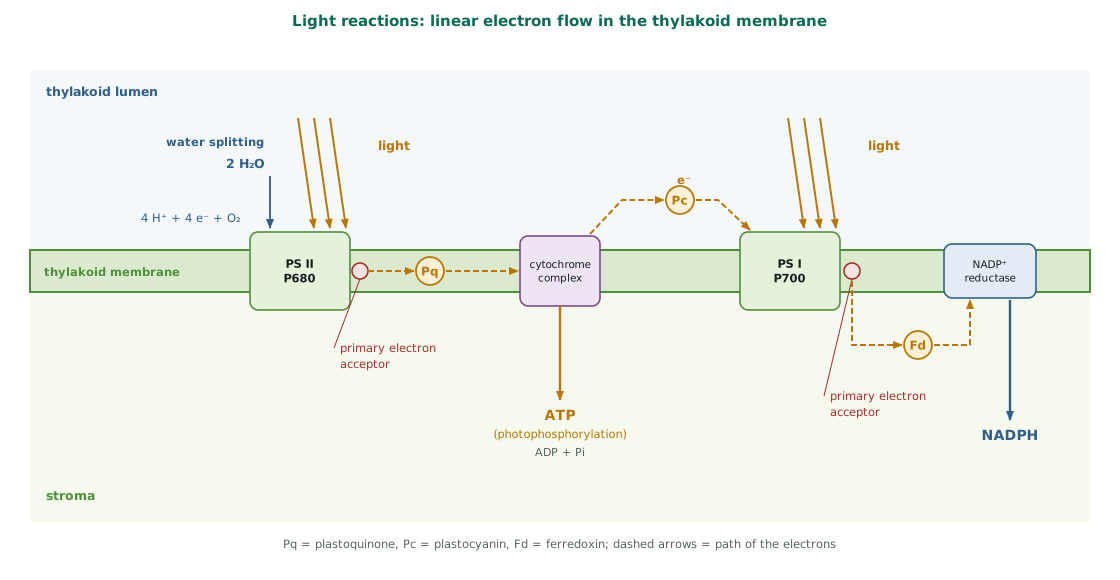
- Photolysis of water (PSII): light excites P680, which loses electrons. Water is split: $2\text{H}_2\text{O} \rightarrow 4\text{H}^+ + 4e^- + \text{O}_2$. The electrons replace those lost by P680, protons accumulate in the thylakoid space, and oxygen is released.
- Electron transport chain: the excited electrons pass along carriers (plastoquinone, cytochrome complex, plastocyanin) to PSI, losing energy at each step. This energy pumps $\text{H}^+$ from the stroma into the thylakoid space, building a proton gradient.
- Photophosphorylation: protons flow back through ATP synthase (chemiosmosis), making ATP from ADP and Pi.
- PSI: light excites P700 and its electrons are passed through ferredoxin to NADP⁺, which is reduced with $\text{H}^+$ to NADPH.
This is non-cyclic photophosphorylation: electrons flow in one direction from water to NADP⁺, giving ATP, NADPH and O₂. In cyclic photophosphorylation electrons from PSI return to PSI via the carriers; only ATP is made, with no NADPH and no O₂. It supplies extra ATP.
The Calvin cycle (light-independent reactions)
The stroma uses ATP and NADPH to turn CO₂ into carbohydrate.
- Carbon fixation: CO₂ combines with ribulose bisphosphate (RuBP, 5C), catalysed by RuBP carboxylase-oxygenase (Rubisco). The unstable 6C product splits into two molecules of glycerate 3-phosphate (GP, 3C).
- Reduction: GP is reduced to triose phosphate (TP, 3C) using ATP and NADPH (which become ADP and NADP⁺ and return to the light reactions).
- Regeneration: five of every six TP molecules are used, with ATP, to regenerate RuBP.
- Products: the remaining TP is used to make glucose (two TP join), starch, sucrose, lipids, amino acids (with nitrate) and other organic molecules.
For each CO₂ fixed, 3 ATP and 2 NADPH are used, so making one glucose needs 18 ATP and 12 NADPH. The cycle stops soon in darkness because ATP and NADPH run out.
C3 and C4 plants
Most plants are C3, the first product being a 3C compound (GP). Rubisco also reacts with O₂ (photorespiration) when CO₂ is low and temperature high, wasting energy. C4 plants (maize, sugarcane, sorghum) have a spatial adaptation: CO₂ is first fixed by PEP carboxylase in mesophyll cells into a 4C acid (oxaloacetate/malate), which is passed to bundle-sheath cells where it releases CO₂ at high concentration for Rubisco. Photorespiration is almost eliminated, so C4 plants do well in hot, bright conditions. CAM plants (pineapple, cacti) fix CO₂ at night and run the Calvin cycle in the day, a temporal separation that saves water.
Limiting factors
The rate of photosynthesis is limited by whichever factor is in shortest supply:
- Light intensity: the rate rises with intensity, then plateaus.
- CO₂ concentration: about $0.04%$ in air, so it often limits. Raising it increases the rate until another factor limits.
- Temperature: enzymes of the Calvin cycle work faster as it rises up to about $35\ ^\circ\text{C}$, then they denature.
- Water, chlorophyll and mineral supply (such as Mg) also affect the rate. Greenhouse growers raise CO₂, light and temperature to improve yield. Photosynthesis can be measured by oxygen evolution (e.g. Elodea, counting bubbles) or by uptake of CO₂.
Deshapriya Senevirathne. B.Sc. (Hons) Biology Special, University of Peradeniya — graduated with a class pass. All the content and lessons in A/L Biology on Paadama are reviewed by Deshapriya Senevirathne, and the lessons are taught by him.