Nucleic acids: DNA, RNA and ATP
Unit 2 · Chemical and Cellular Basis of Life
The structure of a nucleotide, the DNA double helix, the types of RNA, and ATP as the energy currency of the cell.
The nucleotide
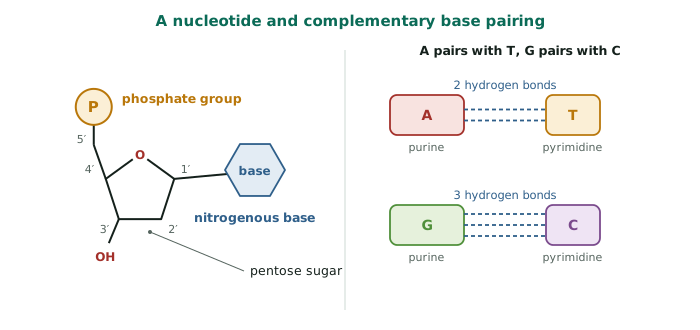
Nucleic acids are polymers of nucleotides. Each nucleotide has three parts:
- a pentose sugar (deoxyribose in DNA, ribose in RNA);
- a phosphate group (attached to carbon 5′ of the sugar);
- a nitrogenous base (attached to carbon 1′).
The bases are of two kinds. The purines (adenine A, guanine G) have a double ring. The pyrimidines (cytosine C, thymine T, uracil U) have a single ring. DNA contains A, G, C and T; RNA contains A, G, C and U.
Nucleotides join in a condensation reaction between the phosphate of one and the 3′ hydroxyl of the sugar of the next, forming a phosphodiester bond. A long sugar-phosphate backbone results, with the bases projecting from it. A chain has a free 5′ phosphate at one end and a free 3′ hydroxyl at the other, so it has direction.
DNA: the double helix
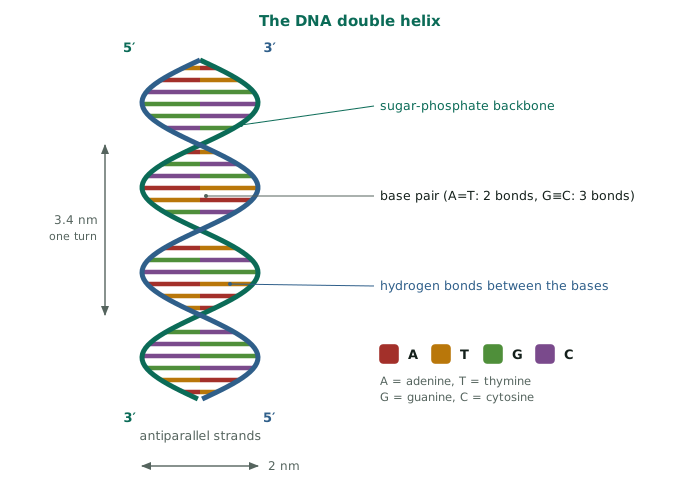
Watson and Crick (1953), using X-ray diffraction data from Franklin and Wilkins, proposed that DNA is a double helix:
- two polynucleotide strands wound round each other, running in opposite directions (antiparallel: one 5′→3′, the other 3′→5′);
- the sugar-phosphate backbones are on the outside and the bases point inwards;
- bases pair by complementary base pairing: A pairs with T by two hydrogen bonds and G pairs with C by three (always a purine with a pyrimidine, so the width is constant);
- one full turn is $3.4\ \text{nm}$ (10 base pairs), and the diameter is $2\ \text{nm}$.
Because of complementary pairing, in any DNA %A = %T and %G = %C (Chargaff's rule). The number of hydrogen bonds makes G-C-rich DNA more stable than A-T-rich DNA.
Functions: DNA stores genetic information as the sequence of bases. Genes are sequences of bases that code for polypeptides. The molecule is stable (strong covalent backbone, protected bases) and can be copied accurately.
Replication is semi-conservative: the helix unwinds, each strand serves as a template for a new complementary strand, and each daughter molecule consists of one old and one new strand (Meselson and Stahl, 1958). It happens in the S phase of the cell cycle.
RNA
RNA differs from DNA in having ribose, uracil instead of thymine, and usually one strand.
| Type | Role |
|---|---|
| Messenger RNA (mRNA) | a copy of a gene, carried from the nucleus to a ribosome; its codons (triplets) specify amino acids |
| Transfer RNA (tRNA) | folded into a clover-leaf; carries a specific amino acid and has an anticodon that pairs with an mRNA codon |
| Ribosomal RNA (rRNA) | forms ribosomes together with proteins |
ATP, the energy currency
ATP (adenosine triphosphate) is a nucleotide: adenine, ribose and three phosphate groups. Hydrolysis of the terminal phosphate bond gives ADP + Pi and releases about $30.6\ \text{kJ mol}^{-1}$, in a single step that cells can couple directly to energy-requiring reactions (active transport, muscle contraction, biosynthesis). ATP is resynthesised from ADP and Pi in respiration (substrate-level and oxidative phosphorylation) and in photosynthesis (photophosphorylation). A cell holds only a small amount of ATP, which is turned over every minute or so, so ATP is not a store but a way of transferring energy.
Deshapriya Senevirathne. B.Sc. (Hons) Biology Special, University of Peradeniya — graduated with a class pass. All the content and lessons in A/L Biology on Paadama are reviewed by Deshapriya Senevirathne, and the lessons are taught by him.