Microbial diseases: transmission, control and antibiotic resistance
How pathogens cause disease, routes of transmission, important diseases of humans, plants and animals (with Sri Lankan examples), the principles of control and prevention, and how antibiotic resistance arises and spreads.
How microbes cause disease
A pathogen is a microbe that causes disease, and the host is the organism it infects. Most microbes are harmless or helpful; pathogens have special features (virulence factors) that help them to enter, stick, avoid defences and damage the host.
- Adhesion and invasion: pili, capsules and surface proteins attach the pathogen to host cells; enzymes (hyaluronidase, collagenase) help it to spread through tissue.
- Evading defences: a capsule stops phagocytosis (Streptococcus pneumoniae); some pathogens live inside phagocytes (Mycobacterium tuberculosis); viruses change their surface antigens (influenza, HIV).
- Toxins: exotoxins are proteins secreted by living bacteria and are very powerful and specific (cholera toxin, tetanus toxin, diphtheria toxin, botulinum toxin); endotoxin is the lipopolysaccharide of the wall of Gram-negative bacteria, released when they die, and causes fever and shock.
- Direct damage by viruses, which kill the host cell as they replicate, and by protozoa such as Plasmodium, which burst red blood cells.
Stages of a disease: incubation (from entry of the pathogen to the first symptoms), prodromal (mild non-specific symptoms), acute (the illness at its height) and convalescence (recovery). Some people become carriers who harbour and spread the pathogen without symptoms (e.g. typhoid carrier, HIV).
Koch's postulates
Robert Koch (late 19th century) set out four criteria to prove that a specific microbe causes a specific disease:
- The microbe must be found in every case of the disease and not in healthy hosts.
- It must be isolated from the sick host and grown in pure culture.
- The pure culture, when injected into a healthy, susceptible host, must cause the same disease.
- The same microbe must be re-isolated from the experimentally infected host.
There are exceptions: viruses cannot be grown on a culture medium, some pathogens (e.g. Treponema) cannot be cultured, and some diseases have several causes.
Transmission of infection
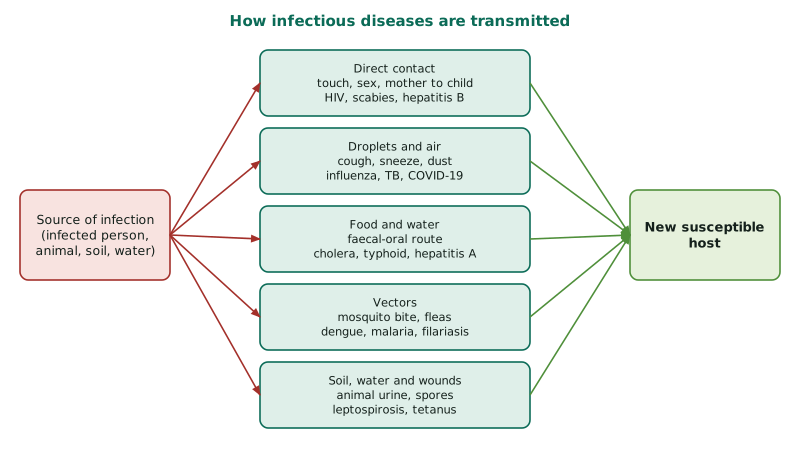
Pathogens spread from a source (reservoir) (people, animals, soil, water) to a new, susceptible host through the chain of infection. Common routes are:
- Direct contact: touch, kissing, sexual intercourse, blood, from mother to child (HIV, hepatitis B, scabies, syphilis, ringworm).
- Droplets and airborne: droplets from coughs and sneezes (influenza, COVID-19, common cold, whooping cough) or tiny particles that stay in the air (TB, measles, chickenpox).
- Contaminated food and water (the faecal-oral route): cholera, typhoid, dysentery, hepatitis A, polio, food poisoning, worm infections.
- Vectors: animals, usually insects, that carry pathogens between hosts. Aedes aegypti and Aedes albopictus (dengue, chikungunya, Zika, yellow fever); Anopheles (malaria); Culex (filariasis, Japanese encephalitis); fleas (plague); sandflies (leishmaniasis); and ticks.
- Soil, water, wounds and objects (fomites): tetanus spores enter wounds from soil; Leptospira from the urine of rats and cattle enters through cuts when walking in water in paddy fields; shared towels and razors.
- Zoonoses are diseases passing from animals to humans: rabies (dogs, bats), leptospirosis, anthrax, bird flu, brucellosis, toxoplasmosis, bovine TB.
- Hospital-acquired (nosocomial) infections spread through contaminated instruments or hands of staff, often with resistant bacteria.
Some important microbial diseases
Diseases of humans
| Disease | Pathogen | Type | Transmission | Notes |
|---|---|---|---|---|
| Tuberculosis (TB) | Mycobacterium tuberculosis | bacterium | airborne droplets | lungs; BCG vaccine; long course of several antibiotics |
| Cholera | Vibrio cholerae | bacterium | contaminated water and food | toxin causes severe watery diarrhoea; oral rehydration |
| Typhoid | Salmonella Typhi | bacterium | faecal-oral | fever, carriers; vaccine, antibiotics |
| Leptospirosis | Leptospira | spirochaete | water contaminated by animal urine | fever, kidney and liver damage; common among paddy farmers |
| Tetanus | Clostridium tetani | bacterium (anaerobe, spores) | soil into wounds | toxin causes muscle spasm; vaccine (DPT), booster |
| Diphtheria, whooping cough | Corynebacterium, Bordetella | bacteria | droplets | vaccine (DPT, pentavalent) |
| Gonorrhoea, syphilis | Neisseria, Treponema | bacteria | sexual contact | antibiotics; STI |
| Dengue | dengue virus (4 serotypes) | RNA virus | Aedes mosquito | fever, bleeding; no specific cure; vector control |
| Chikungunya | chikungunya virus | RNA virus | Aedes mosquito | fever, joint pain |
| Influenza, COVID-19 | influenza virus, SARS-CoV-2 | RNA virus | droplets | vaccines; antivirals |
| Hepatitis A / B | hepatitis viruses | virus | A: food and water; B: blood, sexual | liver damage; vaccine for B |
| Measles, mumps, rubella, polio | viruses | viruses | droplets; faeces (polio) | MMR and polio vaccines |
| Rabies | rabies virus | RNA virus | bite of infected dog or bat | fatal once symptoms start; post-exposure vaccine |
| Malaria | Plasmodium | protozoan | Anopheles mosquito | Sri Lanka is malaria-free since 2016; watch imported cases |
| Amoebic dysentery | Entamoeba histolytica | protozoan | faecal-oral | |
| Candidiasis, ringworm | Candida, Trichophyton | fungi | contact | antifungals |
Filariasis, hookworm and tapeworms are caused by worms, which are not microbes, but they are transmitted in similar ways.
Diseases of plants
Microbial plant diseases reduce yield and quality, and can be devastating.
- Fungi: blister blight of tea (Exobasidium vexans), rice blast (Pyricularia oryzae), Panama wilt of banana (Fusarium), powdery mildew, rusts, coconut leaf blight and brown leaf spot of rice.
- Bacteria: bacterial wilt of tomato, brinjal and potato (Ralstonia solanacearum), citrus canker (Xanthomonas), bacterial leaf blight of rice.
- Viruses: tobacco mosaic virus, leaf curl of chilli and tomato (spread by whiteflies), banana bunchy top virus (aphids), papaya ring spot virus, rice tungro virus (leafhoppers). Plant viruses often cause mosaic patterns, yellowing and stunting.
- Spread: by wind and water-borne spores, infected seed and planting material (cuttings), soil, tools and insect vectors. Control: resistant varieties, crop rotation, clean seed, removing infected plants, fungicides, controlling insect vectors, and biological control.
Diseases of animals
- Anthrax (Bacillus anthracis, spores), foot-and-mouth disease (virus; cattle, buffalo), rabies, brucellosis (Brucella), mastitis (bacteria in the udder), Newcastle disease and avian influenza in poultry, African swine fever, and lumpy skin disease (virus, cattle, in Sri Lanka since 2020) cause serious losses to farmers and some also affect people.
- Control: vaccination, quarantine and movement control, culling, hygiene and disinfection, and veterinary surveillance.
Preventing and controlling infectious disease
Control is based on breaking the chain of infection at the weakest link.
- Reducing the source: finding and treating cases (isolation, antibiotics, antivirals), treating carriers, controlling infected animals (rabies vaccination of dogs, rodent control).
- Blocking transmission:
- Hygiene and sanitation: handwashing, safe drinking water (boiling, chlorination), proper sewage disposal and latrines, food hygiene, covering coughs, masks, safe sex and clean needles.
- Vector control: to prevent dengue, remove the places where Aedes breeds (clear water in tins, coconut shells, tyres, plant pots and roof gutters), use larvicides, insecticide fogging, nets and repellents. Clearing breeding sites is more effective than fogging.
- Quarantine of people exposed to disease, and travel controls.
- Protecting the host: vaccination (immunisation), good nutrition, and prophylactic drugs. Sri Lanka's national immunisation programme includes BCG, pentavalent (DPT, hepatitis B, Hib), polio, MMR, Japanese encephalitis, HPV and tetanus-diphtheria. Smallpox has been eradicated by vaccination and polio is close to it.
- Surveillance and law: notifiable diseases are reported to the Epidemiology Unit of the Ministry of Health; outbreaks are investigated by public health inspectors (PHI) and medical officers of health (MOH).
- Education of the public.
Epidemiology terms: endemic (regularly present in an area), epidemic (sudden increase of cases in an area), pandemic (worldwide epidemic, e.g. COVID-19) and herd immunity (when enough of the population are immune that spread is stopped, protecting the unvaccinated).
Antibiotic resistance
Antibiotic resistance is the ability of bacteria to survive and grow in the presence of an antibiotic that would normally kill them.
How resistance arises and spreads
- Variation: random mutation produces a few resistant cells in any large population (for example 1 in 10⁷ cells).
- Selection: when an antibiotic is used, sensitive bacteria die while the resistant ones survive and multiply: natural selection in action (Unit 3). Frequent use, wrong doses, incomplete courses and use in farm animals increase the selection pressure.
- Spread: resistance genes are carried on plasmids and transposons that move by conjugation (even between species), transformation and transduction, so resistance can be acquired quickly. Resistant bacteria then spread between people, animals, food and hospitals.
Mechanisms of resistance
- Enzymes that destroy the drug, such as β-lactamase, which breaks the β-lactam ring of penicillin.
- Altered target: the antibiotic target (a ribosome or a penicillin-binding protein) is changed so that the drug cannot bind (MRSA).
- Efflux pumps that pump the drug out of the cell.
- Reduced permeability (fewer porins in the outer membrane).
- Alternative pathway that bypasses the blocked step.
Examples and consequences
- MRSA (methicillin-resistant Staphylococcus aureus), a hospital-acquired infection.
- Multidrug-resistant TB (MDR-TB) (resistant to rifampicin and isoniazid) needs two years of treatment with expensive drugs.
- Resistant E. coli, Klebsiella, Salmonella Typhi and gonorrhoea. The WHO considers antimicrobial resistance (AMR) to be one of the greatest threats to global health.
How to slow it down
- Use antibiotics only when needed: not for colds, flu or other viral illnesses. Never take them without a doctor's prescription.
- Take the full course at the correct dose.
- Avoid routine use in farm animals as growth promoters, and avoid antibiotic residues in food.
- Infection control in hospitals (handwashing, isolation, sterilisation) and vaccination.
- Surveillance, rotation and combination therapy (e.g. several drugs for TB), and development of new antibiotics, phage therapy and other alternatives.
Exam tip: Resistance does not develop in the person or the individual bacterium because of the drug; the antibiotic selects bacteria that were already resistant by chance (a mutation or a plasmid) and lets them multiply.