Meiosis and its significance
Unit 2 · Chemical and Cellular Basis of Life
Homologous chromosomes, the stages of meiosis I and II, crossing over and independent assortment, and a comparison with mitosis.
Why meiosis?
Body cells of most animals and plants are diploid (2n): they have two sets of chromosomes, one from each parent, arranged in homologous pairs that carry the same genes (perhaps different alleles) at the same loci. Gametes must be haploid (n), or the chromosome number would double each generation. Meiosis halves the chromosome number. In humans it occurs in the testes and ovaries ($2n = 46 \to n = 23$), and in plants it produces spores in anthers and ovules.
Stages of meiosis
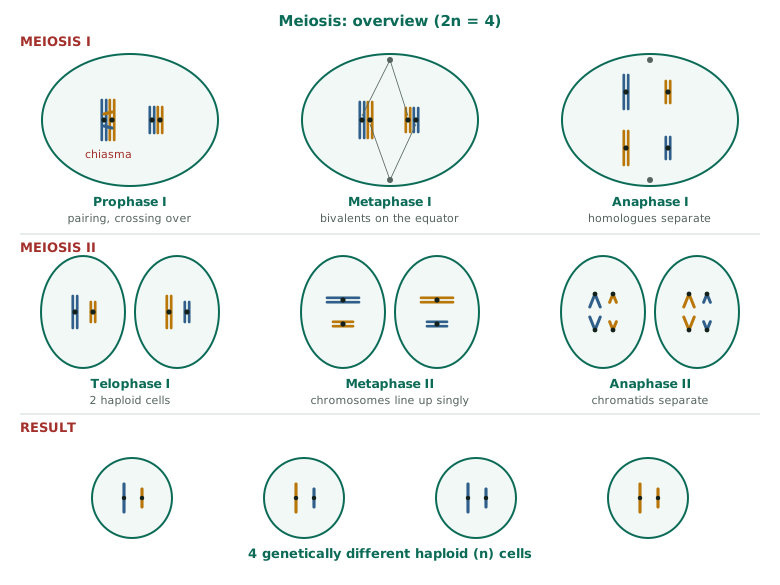
DNA is replicated once in the S phase before meiosis, then the cell divides twice.
Meiosis I (reduction division)
- Prophase I. Chromosomes condense. Homologous chromosomes pair gene for gene (synapsis) to form bivalents (tetrads, with four chromatids). Crossing over: non-sister chromatids break and rejoin, exchanging equivalent segments at points called chiasmata. The nuclear envelope disappears and the spindle forms.
- Metaphase I. Bivalents line up at the equator. The orientation of each pair is random, and spindle fibres attach to one centromere of each homologue.
- Anaphase I. The homologous chromosomes of each bivalent are pulled to opposite poles. The centromeres do not split, so each chromosome still has two chromatids.
- Telophase I and cytokinesis. Two haploid cells result (each chromosome still with two chromatids).
Meiosis II (like mitosis, without DNA replication in between)
- Prophase II: a new spindle forms in each cell.
- Metaphase II: chromosomes line up singly at the equator.
- Anaphase II: centromeres split and sister chromatids move to opposite poles.
- Telophase II and cytokinesis: four haploid cells result.
Sources of genetic variation
- Crossing over (prophase I) produces new combinations of alleles on a chromosome (recombinants), since the chromatids are no longer identical to the parent's.
- Independent assortment (metaphase I): each bivalent lines up independently of the others, so maternal and paternal chromosomes are distributed at random. A cell with $n$ pairs can give $2^n$ different gametes. In humans $2^{23} \approx 8.4$ million.
- Random fertilisation: any sperm can fuse with any egg, so the combinations multiply again.
Genetic variation supplies the raw material for natural selection.
Non-disjunction
If homologues fail to separate in anaphase I (or chromatids in anaphase II) the gametes have an extra or a missing chromosome. Fertilisation then gives $2n+1$ (trisomy) or $2n-1$ (monosomy). Down syndrome is trisomy of chromosome 21 (47 chromosomes).
Mitosis compared with meiosis
| Feature | Mitosis | Meiosis |
|---|---|---|
| Where | All somatic cells, meristems | Reproductive organs (gamete or spore formation) |
| Divisions | One | Two |
| Daughter cells | 2 | 4 |
| Chromosome number | Same (2n → 2n) | Halved (2n → n) |
| Homologues pair | No | Yes, in prophase I |
| Crossing over | No | Yes |
| Genetic make-up | Identical | Different |
| Role | Growth, repair, asexual reproduction | Gamete formation, variation |