Lipids
Unit 2 · Chemical and Cellular Basis of Life
Triglycerides, phospholipids, steroids and waxes: structure, saturated and unsaturated fatty acids, and their roles in energy storage, membranes and insulation.
Properties of lipids
Lipids are a varied group of organic compounds that dissolve in organic solvents (ethanol, ether) but not in water. They are non-polar and hydrophobic because their molecules contain large hydrocarbon regions. They contain C, H and O, but much less oxygen than carbohydrates, so oxidising a gram of lipid releases about $38\ \text{kJ}$, more than twice the energy of a gram of carbohydrate.
Triglycerides
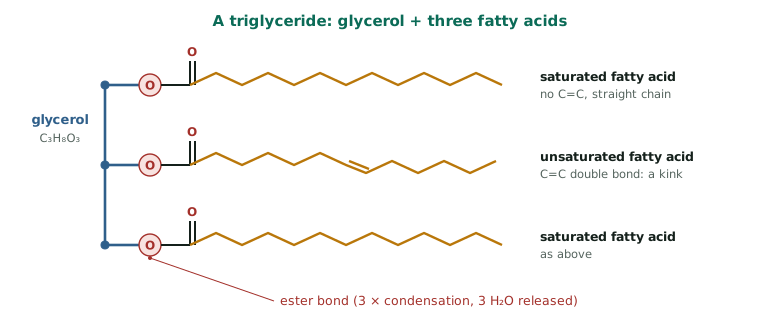
A triglyceride (fat or oil) is made of one glycerol (a three-carbon alcohol with three $\text{-OH}$ groups) and three fatty acids (a hydrocarbon chain with a $\text{-COOH}$ group). Each fatty acid joins to glycerol by an ester bond in a condensation reaction, so three water molecules are released.
- In a saturated fatty acid every carbon in the chain carries the maximum number of hydrogens, so there are no double bonds. The chains are straight, pack closely and give solid fats at room temperature (butter, animal fat).
- An unsaturated fatty acid has one (mono-) or more (poly-) $\text{C=C}$ double bonds, which put kinks in the chain. The molecules pack less closely, so these are liquid oils (olive oil, most plant oils).
Functions of triglycerides:
- long-term energy store, compact because it is non-polar and unhydrated;
- thermal insulation (blubber, subcutaneous fat) and protection of organs such as the kidneys;
- a source of metabolic water on oxidation, important in desert animals such as camels;
- buoyancy and waterproofing (oil on feathers and fur).
Phospholipids
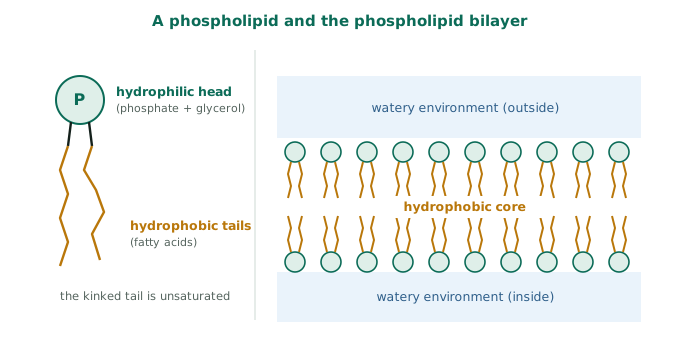
A phospholipid is like a triglyceride except that one fatty acid is replaced by a phosphate group. The phosphate "head" is polar and hydrophilic; the two fatty-acid "tails" are non-polar and hydrophobic, so the molecule is amphipathic. In water, phospholipids arrange themselves into a bilayer with the heads facing the water and the tails facing each other. This is the basic structure of all cell membranes.
Other lipids
- Waxes (fatty acid + a long-chain alcohol) form a waterproof layer on leaves (cuticle), insect exoskeletons and bird feathers.
- Steroids have four fused carbon rings, not fatty acids. Cholesterol is in animal cell membranes (it regulates their fluidity) and is the precursor of steroid hormones (oestrogen, testosterone), bile salts and vitamin D.
- Fat-soluble vitamins (A, D, E, K) and carotenoid pigments are lipid-soluble.
Emulsion test
Mix the sample with ethanol, shake so that any lipid dissolves, and pour the clear liquid into water. Lipid is no longer soluble and forms tiny droplets that scatter light, giving a cloudy white emulsion. Sudan III stain also dyes lipid red.
Deshapriya Senevirathne. B.Sc. (Hons) Biology Special, University of Peradeniya — graduated with a class pass. All the content and lessons in A/L Biology on Paadama are reviewed by Deshapriya Senevirathne, and the lessons are taught by him.