The flower, gametes and pollination
Unit 4 · Plant Form and Function
Flower structure, the formation of pollen grains (microsporogenesis) and the embryo sac (megasporogenesis), pollination and its agents, adaptations of wind- and insect-pollinated flowers, and the prevention of self-pollination.
Structure of a flower
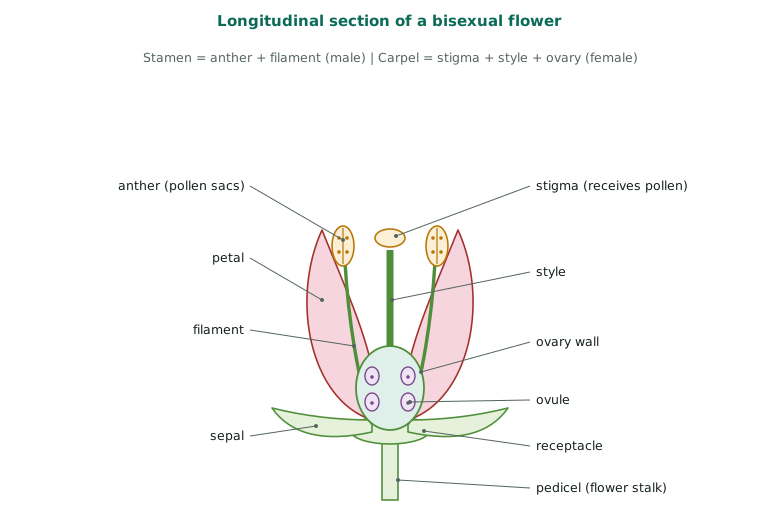
A flower is a shoot of limited growth modified for sexual reproduction. Its parts are attached to the swollen tip of the flower stalk (pedicel), the receptacle, in four whorls (rings):
| Whorl | Parts | Function |
|---|---|---|
| Calyx | Sepals (usually green) | Protect the flower bud |
| Corolla | Petals (often coloured and scented, with nectar guides) | Attract pollinators |
| Androecium (male) | Stamens: an anther (with four pollen sacs) on a filament | Produce pollen grains |
| Gynoecium (female) | One or more carpels (a single one is a pistil): stigma (receives pollen), style, ovary with one or more ovules | Produce the embryo sac and the egg; the ovary becomes the fruit |
Nectar made in nectaries (usually at the base of the carpel or petals) rewards insect visitors. Calyx and corolla together are called the perianth; if the sepals and petals look alike (as in lily), they are tepals. A flower with both stamens and carpels is bisexual (hermaphrodite); one with only one kind is unisexual. When the ovary lies above the other parts it is superior (hypogynous) as in hibiscus; when it lies below, it is inferior (epigynous), as in banana or cucumber.
Making pollen: microsporogenesis
Each anther has four pollen sacs. Inside, diploid microspore mother cells (pollen mother cells) divide by meiosis to form a tetrad of four haploid microspores. The inner layer of the sac, the tapetum, nourishes them. Each microspore divides once by mitosis to give a pollen grain (the male gametophyte) with two haploid nuclei: a tube nucleus (large) and a generative nucleus (small). The pollen wall has a tough outer layer (exine, made of sporopollenin) with sculpture and pores, and an inner layer (intine). When the anther opens (dehiscence), pollen is released. The generative nucleus later divides by mitosis (in the pollen tube, or earlier in some plants) to give two male gametes, which are the sperm cells.
Making the embryo sac: megasporogenesis
An ovule has a stalk (funicle), a mass of tissue (nucellus) surrounded by one or two protective integuments, with a small gap, the micropyle, at one end, and the chalaza at the opposite end. In the nucellus one diploid megaspore mother cell divides by meiosis to make four haploid megaspores in a row. Three degenerate (those nearest the micropyle), and the one remaining, the functional megaspore, divides by three successive mitoses to give 8 haploid nuclei. After the cell walls form, the embryo sac (the female gametophyte) contains seven cells:
- at the micropyle end the egg apparatus: one egg cell (the female gamete) and two synergids (guide the pollen tube);
- at the chalazal end three antipodal cells;
- a large central cell in the middle with two polar nuclei (so it has 8 nuclei in 7 cells in total).
(See the ovule diagram in the next lesson.)
Pollination
Pollination is the transfer of pollen from an anther to a stigma of the same species. It is not the same as fertilisation.
- Self-pollination: pollen is transferred to a stigma of the same flower or another flower of the same plant. It needs no agent and is reliable, but gives low variation (inbreeding). Examples: some beans, rice and tomato. Some flowers do it without opening (cleistogamy).
- Cross-pollination: pollen is carried to a flower on a different plant of the same species. It gives genetic variation and a more adaptable population, but needs an agent and many pollen grains.
Agents of cross-pollination
| Agent | Flower features | Examples |
|---|---|---|
| Wind (anemophily) | Small, dull flowers without scent or nectar; large feathery stigmas hanging outside; anthers on long filaments, exposed to wind; light, smooth, abundant pollen | Grasses, paddy, maize, coconut, pine |
| Insects (entomophily: bees, butterflies, moths, flies, beetles) | Brightly coloured or scented petals, nectar guides, nectar; sticky or spiny pollen in smaller amounts; sticky stigma inside the flower | Hibiscus, ixora, mango, sunflower, coconut flowers also visited by bees |
| Birds (ornithophily) | Red or orange, tubular flowers with plenty of nectar and no scent | Erythrina, Canna |
| Bats (chiropterophily) | Large, pale, strong-smelling flowers opening at night | Durian, banana, kapok |
| Water (hydrophily) | Pollen with a thin wall that floats | Hydrilla, Vallisneria |
Exam tip: Compare wind- and insect-pollinated flowers in a two-column table with the same features (petals, scent, nectar, anthers, stigma, pollen) so each difference is explicit.
Preventing self-pollination
Plants have a variety of devices to favour cross-pollination:
- Dioecy: male and female flowers are on different plants (papaw, nutmeg, date palm).
- Monoecy: separate male and female flowers on the same plant (maize, coconut, cucumber, pumpkin), which reduces but does not prevent self-pollination.
- Dichogamy: the stamens and carpels of a flower mature at different times: protandry (anthers first; sunflower, many bisexual flowers) or protogyny (carpels first; avocado).
- Herkogamy: the stigma is placed so that pollen cannot easily reach it, as in heterostyly (different style lengths in different flowers, e.g. primrose).
- Self-incompatibility: pollen of the same plant fails to germinate, or grow its tube, because of recognition by self-incompatibility genes (S alleles); this is a common mechanism.
Pollination in agriculture
Many crops (mango, pumpkin, coconut, passion fruit) depend on insects, and so bee decline harms yields. Farmers may keep honey bees, grow flowers nearby, avoid spraying insecticide in flowering, or hand-pollinate (vanilla, pumpkin, papaw).
Exam tip: Pollination is the transfer of pollen; fertilisation is the fusion of gametes. They may be separated by hours (maize) to months (some oaks).