Enzymes
Unit 2 · Chemical and Cellular Basis of Life
Enzymes as biological catalysts: the active site, lock-and-key and induced-fit models, activation energy, factors affecting rate, cofactors and inhibition.
Enzymes as biological catalysts
Almost every reaction in a cell is catalysed by an enzyme. Enzymes are globular proteins (a few are RNA) that
- speed up reactions by lowering the activation energy, the energy needed to start a reaction;
- are not used up or changed, so a small amount can be used repeatedly;
- do not change the equilibrium, only how fast it is reached;
- are specific: each acts on one substrate (or a group of similar substrates);
- work in mild conditions of temperature and pH.
Enzymes are named for their substrate with the ending -ase (amylase, lipase, protease, catalase). Some work inside cells (intracellular, such as catalase and those of respiration), and some are secreted (extracellular, such as digestive enzymes).
How enzymes work
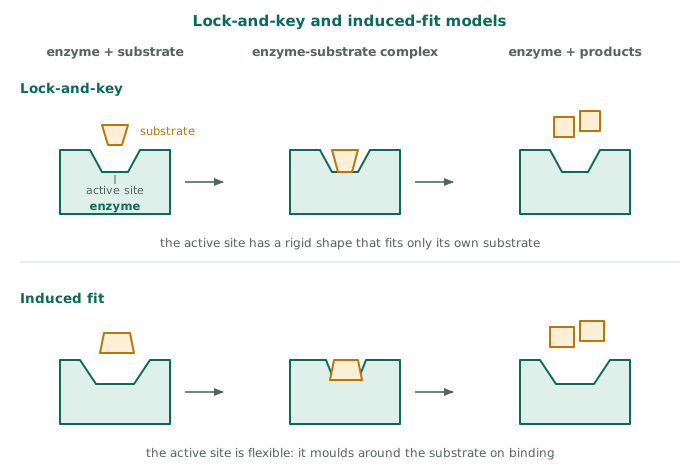
Only a small region of the enzyme, the active site, takes part. The substrate binds to it by weak interactions, forming an enzyme-substrate complex. The active site stresses the bonds of the substrate or brings reactants together in the right orientation, which lowers the activation energy. The product leaves, and the enzyme is free for another substrate.
- Lock-and-key model (Fischer, 1894): the active site has a rigid shape exactly complementary to its substrate.
- Induced-fit model (Koshland, 1958): the active site is flexible; binding of the substrate changes its shape so that it fits closely. This explains why enzymes can act on a group of similar substrates and how binding strains the substrate.
Factors affecting the rate
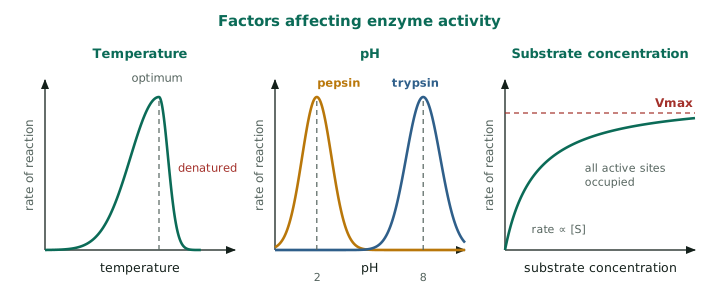
- Temperature. As temperature rises, molecules have more kinetic energy and collide more often, so the rate rises (about doubling for every $10\ ^\circ\text{C}$). Above the optimum the weak bonds that hold the tertiary structure break, the active site loses its shape and the enzyme is denatured, so the rate falls rapidly. At low temperatures enzymes are inactive but not denatured.
- pH. Changing pH alters the charges of the R groups in and near the active site, disrupting ionic and hydrogen bonds. Each enzyme has an optimum pH (pepsin about 2, amylase of saliva about 7, trypsin about 8.5). Extreme pH denatures the enzyme.
- Substrate concentration. At low concentration the rate is proportional to it. As more active sites are occupied the rate levels off at $V_{max}$ when all the enzyme molecules are working at their maximum rate.
- Enzyme concentration. If substrate is in excess, the rate is proportional to the enzyme concentration.
Cofactors and inhibition
- Cofactors are non-protein helpers: inorganic ions (Cl⁻ for amylase, Zn²⁺ for carbonic anhydrase), coenzymes (organic, often derived from vitamins, such as NAD, FAD and coenzyme A, which carry hydrogens or groups) and prosthetic groups (tightly bound, such as haem in catalase).
- A competitive inhibitor has a shape similar to the substrate and occupies the active site. Increasing substrate concentration reduces its effect.
- A non-competitive inhibitor binds to a different site (an allosteric site), changing the shape of the active site. Increasing the substrate does not overcome it.
- In end-product inhibition the final product of a pathway inhibits an enzyme early in the pathway, which regulates metabolism.
Deshapriya Senevirathne. B.Sc. (Hons) Biology Special, University of Peradeniya — graduated with a class pass. All the content and lessons in A/L Biology on Paadama are reviewed by Deshapriya Senevirathne, and the lessons are taught by him.