Energy relationships in metabolism and ATP
Unit 2 · Chemical and Cellular Basis of Life
Anabolic and catabolic reactions, exergonic and endergonic changes, energy flow in the biosphere, the structure and hydrolysis of ATP, and the three kinds of phosphorylation.
Metabolism and energy
All the biochemical reactions of an organism are metabolic reactions, and they are of two kinds.
- Catabolic reactions break complex molecules into simpler ones and release free energy. They are exergonic.
- Anabolic reactions build complex molecules from simple ones and absorb free energy. They are endergonic.
Energy is the capacity to do work. Living cells need it for:
- synthesis of substances;
- active transport across the plasma membrane;
- transmission of nerve impulses;
- muscle contraction;
- movement of cilia and flagella;
- bioluminescence;
- electric discharge (as in some fish).
Energy flow in the biosphere
- Energy enters living systems from the environment as solar radiation. The sun is the primary source.
- Photosynthetic cells that contain chlorophyll store light energy as chemical energy in organic compounds such as carbohydrates.
- Cellular respiration converts the energy stored in food into chemical energy in ATP.
- The energy of ATP is used for all the processes that need energy.
ATP: the energy carrier
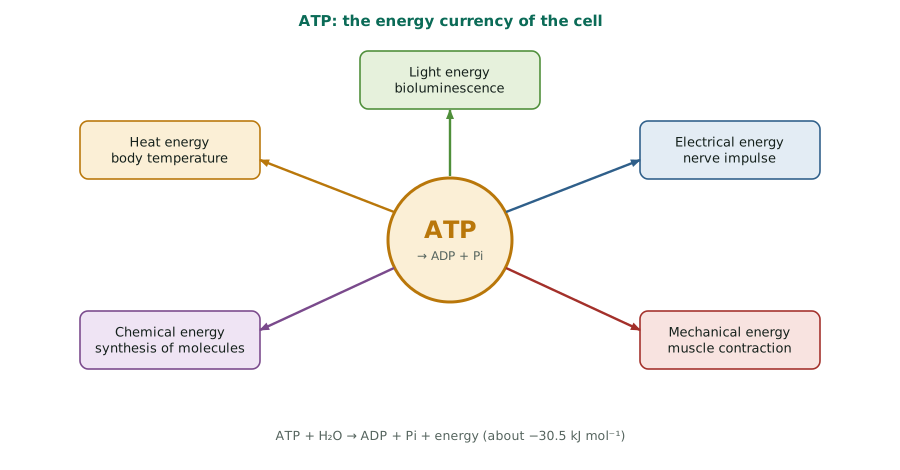
ATP (adenosine triphosphate) is the energy carrier in all organisms, even the simplest bacteria, and is called the "universal currency" of energy. It is a nucleotide made of the sugar ribose, the nitrogenous base adenine and a chain of three phosphate groups. You do not need to memorise its detailed chemical structure.
Hydrolysis of ATP removes the terminal phosphate group: ATP + H₂O → ADP + Pi + energy. A large amount of energy is released, because ATP and water hold more energy than ADP and Pi. It is an exergonic reaction, with a free energy change of −30.5 kJ/mol.
Many reactions use the energy released when this terminal phosphate bond breaks. ATP is mobile, so it takes energy to any part of the cell. It is also quickly made again from ADP + Pi + energy. Making ATP in the cell is phosphorylation.
The energy of ATP is changed into light (bioluminescence), electrical energy (nerve impulses), mechanical energy (muscle contraction), chemical energy (synthesis of compounds) and heat (to keep the body warm).
Three kinds of phosphorylation
| Type | Source of the energy |
|---|---|
| Photophosphorylation | Solar energy, in photosynthesis |
| Substrate-level phosphorylation | Energy released when complex molecules break down |
| Oxidative phosphorylation | Energy released by oxidation of molecules |
The last two take place in cellular respiration.
Exam tip: Energy is released when ATP is hydrolysed because the products are lower in energy than the reactants, not because the phosphate bond is "high-energy" in itself. Learn the three phosphorylations with their energy sources.
Deshapriya Senevirathne. B.Sc. (Hons) Biology Special, University of Peradeniya — graduated with a class pass. All the content and lessons in A/L Biology on Paadama are reviewed by Deshapriya Senevirathne, and the lessons are taught by him.