The endocrine system and hormones
Unit 5 · Animal Form and Function
The endocrine glands and their hormones, how hormones act on target cells, the pituitary as the controlling gland, feedback control, and disorders of hormone production.
Endocrine glands and hormones
The endocrine system is made of ductless glands that secrete hormones directly into the blood. A hormone travels all over the body but affects only its target cells, which have receptors for it. Hormones act in tiny amounts, take effect more slowly than nerve impulses, and often last longer. Hormones are broken down in the liver and lost in the urine, so their effect fades unless more is released.
How hormones act
- Steroid hormones (oestrogen, testosterone, cortisol) and thyroxine are lipid-soluble. They pass through the plasma membrane, bind to a receptor in the cytoplasm or nucleus, and the complex switches particular genes on or off, changing protein synthesis.
- Peptide and amine hormones (insulin, glucagon, adrenaline, ADH) are water-soluble. They cannot enter the cell, so they bind to a receptor on the cell surface. This activates a second messenger inside (such as cyclic AMP), which starts a cascade of enzyme reactions that amplifies the signal. For example, adrenaline on a liver cell activates enzymes that release glucose from glycogen.
The main glands and their hormones
| Gland | Hormone | Main effects |
|---|---|---|
| Hypothalamus | Releasing and inhibiting hormones; makes ADH and oxytocin | Controls the pituitary |
| Anterior pituitary | Growth hormone (GH) | Growth of bone and muscle, protein synthesis |
| TSH | Stimulates the thyroid | |
| ACTH | Stimulates the adrenal cortex | |
| FSH, LH | Control the gonads (gametes, sex hormones, ovulation) | |
| Prolactin | Milk production | |
| Posterior pituitary (stores and releases) | ADH (antidiuretic hormone) | Makes the kidney tubules reabsorb more water |
| Oxytocin | Contraction of the uterus; milk ejection | |
| Thyroid | Thyroxine (contains iodine) | Raises metabolic rate; growth and development |
| Calcitonin | Lowers blood calcium | |
| Parathyroids | Parathormone | Raises blood calcium (acts on bone, kidney, gut) |
| Adrenal medulla | Adrenaline, noradrenaline | Fight or flight: higher heart rate, glucose release, blood diverted to muscles |
| Adrenal cortex | Cortisol; aldosterone | Cortisol: long-term stress, raises blood glucose; aldosterone: Na⁺ reabsorption |
| Pancreas (islets) | Insulin; glucagon | Lower and raise blood glucose |
| Ovary | Oestrogen; progesterone | Female characters; menstrual cycle; pregnancy |
| Testis | Testosterone | Male characters; sperm production |
| Pineal gland | Melatonin | Sleep and daily rhythm |
| Thymus | Thymosin | Maturation of T cells (large in childhood) |
The pituitary gland: the master gland
The pituitary hangs from the hypothalamus. The posterior lobe is an extension of the brain: ADH and oxytocin are made by neurosecretory cells in the hypothalamus and pass down their axons to be released here. The anterior lobe is made of glandular tissue and releases its hormones when the hypothalamus sends releasing hormones through a small portal blood system. Through TSH, ACTH, FSH and LH it controls other glands, so it is called the "master gland", although the hypothalamus controls it. This is the link between the nervous and endocrine systems.
Feedback control
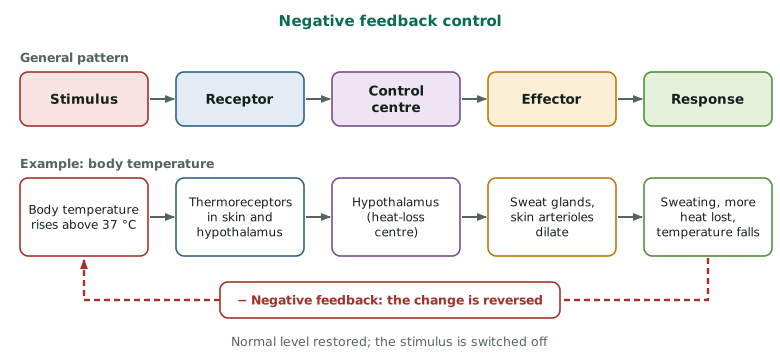
Hormone levels are kept in a narrow range mainly by negative feedback: when the level of a hormone or of the substance it controls rises above the set point, the response reduces it, and vice versa.
For example, a low level of thyroxine in the blood makes the hypothalamus release TRH and the pituitary release TSH. TSH makes the thyroid secrete more thyroxine. When the thyroxine level is high enough it inhibits the hypothalamus and the pituitary, so TSH falls.
In positive feedback the response increases the original stimulus. In childbirth the stretching of the cervix by the baby's head sends impulses that make the posterior pituitary release oxytocin; oxytocin strengthens the contractions, which stretch the cervix further, and so on until the baby is born.
Disorders of the endocrine system
| Disorder | Cause | Effects |
|---|---|---|
| Simple goitre | Iodine deficiency: not enough thyroxine, so the thyroid is over-stimulated by TSH | Swelling of the neck; prevented by iodised salt |
| Hyperthyroidism (Graves' disease) | Excess thyroxine | High metabolic rate, weight loss, sweating, rapid heartbeat, protruding eyes |
| Hypothyroidism | Too little thyroxine | Slow metabolism, weight gain, tiredness; in babies, cretinism with poor growth and brain development |
| Gigantism / acromegaly | Too much growth hormone in childhood / in adults | Excessive height / enlarged hands, feet and face |
| Pituitary dwarfism | Too little GH in childhood | Short stature with normal proportions |
| Diabetes insipidus | Too little ADH | Large volumes of dilute urine and great thirst |
| Diabetes mellitus | Lack of insulin or loss of response to it | High blood glucose (see the next lesson) |
| Cushing's syndrome / Addison's disease | Too much / too little cortisol | Fat redistribution and high blood pressure / weakness and low blood pressure |
Hormones in other animals
Insect development is controlled by hormones: ecdysone from the prothoracic gland triggers moulting, and juvenile hormone from the corpora allata keeps the larval characters. In amphibians thyroxine triggers metamorphosis of a tadpole into a frog; a tadpole lacking iodine remains a tadpole.
Exam tip: Remember the two modes of action: steroid hormones enter the cell and act on genes; peptide hormones act at the surface through a second messenger. For feedback questions state the stimulus, the receptor, the control centre, the effector and the response in order.