Cytoskeleton, cilia and flagella, centrioles and the central vacuole
Unit 2 · Chemical and Cellular Basis of Life
The three parts of the cytoskeleton (Table 2.5), the 9+2 structure of cilia and flagella, centrioles and the centrosome, and the central vacuole.
Cytoskeleton
The cytoskeleton supports the cell and maintains its shape, which is especially important in animal cells, which have no cell wall. It is made of microtubules and protein filaments, and it is dynamic: its parts can be taken apart and put together again. It has three components:
| Component | Structure | Subunit |
|---|---|---|
| Microtubules | hollow tubes whose wall is made of 13 columns of tubulin | tubulin |
| Microfilaments (actin filaments) | two intertwined strands of actin, each a polymer of actin subunits | actin |
| Intermediate filaments | fibrous proteins supercoiled into thicker cables | one of several proteins depending on the cell type (e.g. keratin) |
Functions: mechanical support for the cytoplasm; anchoring organelles and cytosolic enzymes in place; cytoplasmic movement and cytoplasmic streaming; moving chromosomes; maintaining the shape of the cell (mainly animal cells).
Cilia and flagella
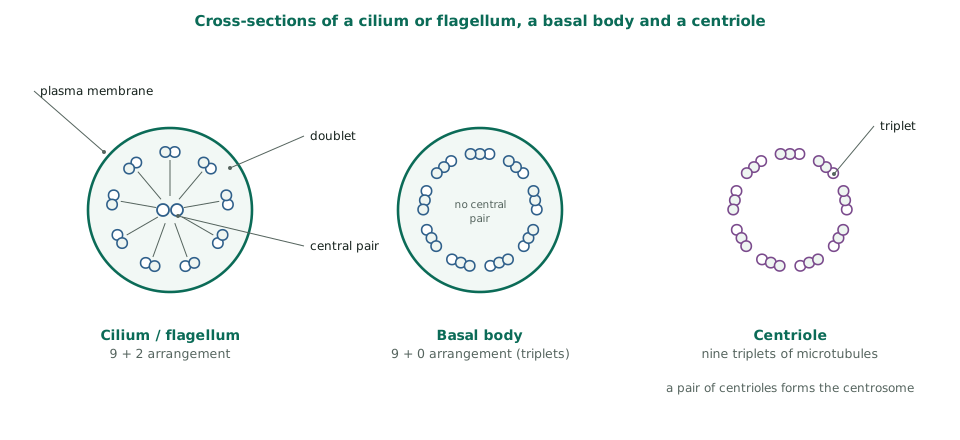
Cilia and flagella have the same basic structure. Flagella are long and few; cilia are short, arranged in rows and more numerous.
- Both have the 9+2 arrangement of microtubules (nine doublets in a ring and two single microtubules in the centre).
- Both are covered by the plasma membrane.
- Both are anchored by a basal body, which has a 9+0 arrangement (no central pair).
- Functions: locomotion; moving fluid over the surface of tissues. For example, cilia in the oviduct move the egg towards the uterus.
Centrioles and the centrosome
Centrioles are cylinders of microtubules that are not bounded by a membrane and occur only in animal cells. Each has nine triplets of microtubules (9+0) in a ring. A pair of centrioles at right angles to each other, near the nucleus, forms the centrosome. Function: they produce the spindle and asters during cell division.
Central vacuole
The central vacuole is a large, fluid-filled organelle of plant cells, bounded by the tonoplast. It contains cell sap: water, ions such as K⁺ and Cl⁻ and sometimes water-soluble pigments such as anthocyanins. Other kinds of vacuole are food vacuoles and contractile vacuoles.
Functions: stores water, sugars, ions and pigments; maintains the water balance of the cell (osmoregulation); gives turgidity and support; sap pigments colour parts of the plant; helps in digestion.
Exam tip: Remember the numbers: tubulin 13 columns; actin two strands; cilium 9+2; basal body and centriole 9+0 (centriole = nine triplets). Centrioles are only in animal cells and are not membrane-bound.
Deshapriya Senevirathne. B.Sc. (Hons) Biology Special, University of Peradeniya — graduated with a class pass. All the content and lessons in A/L Biology on Paadama are reviewed by Deshapriya Senevirathne, and the lessons are taught by him.