Characteristics of living organisms
Unit 1 · Introduction to Biology
The features that distinguish living from non-living things: cells, metabolism, growth, reproduction, response, homeostasis, movement and adaptation.
Is it alive?
A rock, a fire, a car and a dog all seem to "do things", yet only the dog is alive. No single feature defines life; instead, living things show all of the following characteristics together.
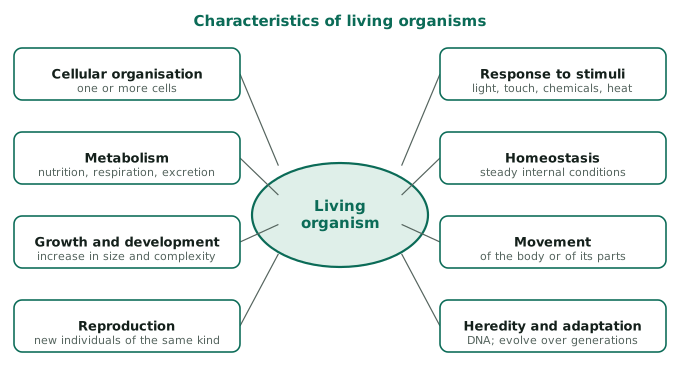
1. Cellular organisation
All living things are made of one or more cells, surrounded by a membrane and containing genetic material (DNA). The cell is the smallest unit that can carry out all the functions of life. Unicellular organisms are one cell; multicellular organisms have many, arranged into tissues and organs.
2. Metabolism
Metabolism is the sum of all the chemical reactions in an organism, controlled by enzymes. It includes:
- anabolism: building larger molecules from smaller ones (for example photosynthesis, protein synthesis), which needs energy;
- catabolism: breaking molecules down (for example respiration, digestion), which releases energy.
Metabolism covers nutrition (obtaining food), respiration (releasing energy from food), excretion (removing the waste products of metabolism, such as $\text{CO}_2$ and urea) and transport of materials. Organisms are open systems: they take in matter and energy from the environment and give out waste, which keeps them far from chemical equilibrium.
3. Growth and development
Growth is a permanent increase in size, mainly by increase in cell number (cell division) and cell size. Development is the series of changes in form and function through the life cycle (a seed to a flowering plant, a tadpole to a frog). A crystal also "grows", but only by adding material to the outside; a living thing grows from within, using materials it has changed by metabolism.
4. Reproduction
Reproduction produces new individuals and maintains the species. Asexual reproduction involves one parent and gives genetically identical offspring (binary fission, budding, vegetative propagation). Sexual reproduction involves the fusion of gametes and gives genetically varied offspring. Reproduction is a property of the species: an individual can live without reproducing.
5. Response to stimuli
A stimulus is a change in the environment that an organism detects (light, temperature, touch, chemicals, gravity). Animals respond using the nervous and hormonal systems; plants respond more slowly, for example by shoots growing towards light (phototropism) or leaves of the Mimosa (touch-me-not) folding when touched. Response to stimuli helps the organism find food, avoid danger and survive.
6. Homeostasis
Homeostasis is the maintenance of a relatively steady internal environment (body temperature, blood glucose, pH, water content) even though the external environment changes. It works mainly by negative feedback, which you will meet again in Animal Form and Function.
7. Movement
Animals usually move the whole body (locomotion). Plants and fungi mostly move only parts, by growth movements (tropisms) or turgor changes (stomata opening, leaves of Mimosa). Movement may be at the cellular level too (cytoplasmic streaming, movement of chromosomes, beating of cilia).
8. Heredity, adaptation and evolution
Heredity passes characteristics from parents to offspring through genes in DNA. A population shows variation, and individuals with adaptations (inherited features that suit the environment) survive and reproduce better. Over generations this is natural selection, leading to evolution: the change in the inherited characteristics of populations. Evolution is a characteristic of populations over time rather than of individuals.
Borderline cases: are viruses alive?
Viruses carry genes (DNA or RNA) in a protein coat and evolve, but they:
- are not cellular;
- have no metabolism of their own;
- reproduce only by taking over the machinery of a host cell.
Most biologists therefore treat viruses as non-cellular infectious particles that lie on the border of life; they are studied in Microbiology. Dead organisms and dormant seeds or spores are further special cases: a seed has a very low metabolic rate but can resume growth.
Exam tip: When asked whether something is alive, never rely on one feature. Fire moves, grows and uses oxygen but has no cells, no heredity and no homeostasis. A mule is alive although it cannot reproduce, because reproduction is a characteristic of the species.
Deshapriya Senevirathne. B.Sc. (Hons) Biology Special, University of Peradeniya — graduated with a class pass. All the content and lessons in A/L Biology on Paadama are reviewed by Deshapriya Senevirathne, and the lessons are taught by him.