Cellular respiration
Unit 2 · Chemical and Cellular Basis of Life
Aerobic respiration: glycolysis, the link reaction, the Krebs cycle and oxidative phosphorylation, ATP yield, anaerobic respiration and fermentation, and respiratory quotient.
What respiration does
Cellular respiration is the controlled breakdown of organic molecules (usually glucose) to release energy, which is trapped in ATP. It is a series of enzyme-catalysed oxidations, mostly dehydrogenation, in which hydrogen is removed by the coenzymes NAD⁺ and FAD, which become NADH and FADH₂.
$$\text{C}6\text{H}{12}\text{O}_6 + 6\text{O}_2 \rightarrow 6\text{CO}_2 + 6\text{H}_2\text{O} + \text{energy}$$
The complete oxidation of glucose releases about $2870\ \text{kJ mol}^{-1}$, of which about 40% is conserved in ATP and the rest is lost as heat (which keeps mammals warm).
Glycolysis
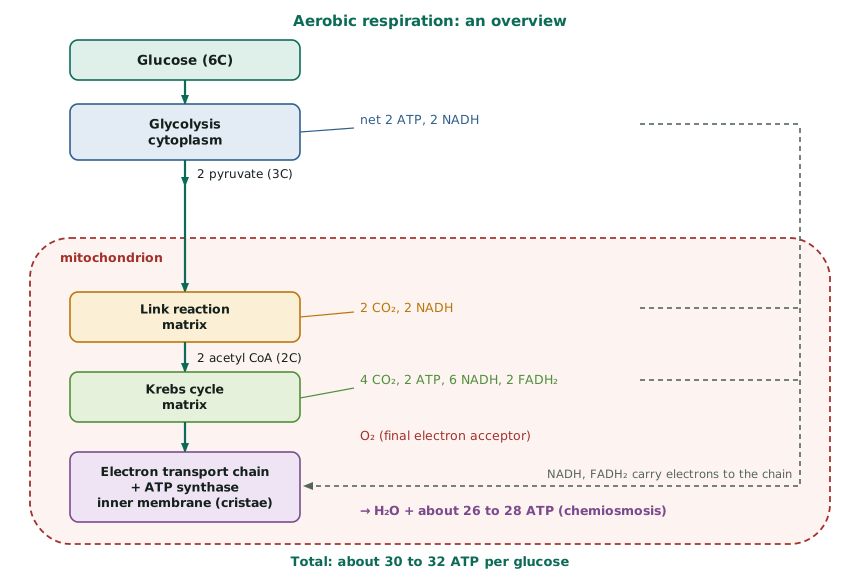
Takes place in the cytoplasm and needs no oxygen.
- Glucose is phosphorylated twice using 2 ATP, forming fructose 1,6-bisphosphate (6C), which is more reactive.
- It splits into two triose phosphate (3C) molecules.
- Each triose phosphate is oxidised (NAD⁺ → NADH) and converted to pyruvate (3C), with 4 ATP formed by substrate-level phosphorylation.
Net yield per glucose: 2 ATP, 2 NADH and 2 pyruvate.
Link reaction
When oxygen is present, pyruvate enters the mitochondrial matrix (by active transport). Each pyruvate is decarboxylated (CO₂ removed) and dehydrogenated (NAD⁺ → NADH), and the 2C acetyl group combines with coenzyme A to form acetyl CoA. Per glucose: 2 CO₂, 2 NADH, 2 acetyl CoA.
Krebs cycle
In the matrix, acetyl CoA (2C) combines with oxaloacetate (4C) to give citrate (6C). In a series of steps citrate is decarboxylated twice (releasing 2 CO₂) and dehydrogenated four times, giving 3 NADH, 1 FADH₂ and 1 ATP (substrate-level) per turn, and oxaloacetate is regenerated. Per glucose (two turns): 4 CO₂, 6 NADH, 2 FADH₂, 2 ATP.
Oxidative phosphorylation
On the inner mitochondrial membrane (cristae):
- NADH and FADH₂ are oxidised and donate electrons to the electron transport chain (carriers I to IV).
- The electrons lose energy step by step; this energy is used to pump $\text{H}^+$ from the matrix into the intermembrane space, producing a proton gradient.
- Protons flow back through ATP synthase, which makes ATP from ADP and Pi (chemiosmosis).
- At the end of the chain oxygen is the final electron acceptor and combines with electrons and $\text{H}^+$ to form water. Without oxygen the chain stops and NADH cannot be reoxidised.
Each NADH gives about 2.5 ATP and each FADH₂ about 1.5 ATP.
ATP yield per glucose
| Stage | Net ATP made directly | NADH | FADH₂ |
|---|---|---|---|
| Glycolysis | 2 | 2 | 0 |
| Link reaction | 0 | 2 | 0 |
| Krebs cycle | 2 | 6 | 2 |
| Total | 4 | 10 | 2 |
Oxidative phosphorylation gives $10 \times 2.5 + 2 \times 1.5 = 28$ ATP; adding the 4 from substrate-level phosphorylation and subtracting 2 (the cost of moving NADH into the mitochondrion) gives about 30 to 32 ATP per glucose (older textbooks state 36 or 38).
Anaerobic respiration
Without oxygen, glycolysis alone supplies ATP (2 per glucose). The NADH must be reoxidised to NAD⁺ so that glycolysis can continue:
- Lactate fermentation (animal muscle, some bacteria): pyruvate + NADH → lactate + NAD⁺. Lactate builds up and is carried to the liver, where it is converted back to glucose, the "oxygen debt" being repaid.
- Alcoholic fermentation (yeast, plant roots in waterlogged soil): pyruvate → ethanal + CO₂, then ethanal + NADH → ethanol + NAD⁺. This is used in brewing and baking. Anaerobic respiration releases only about 2 ATP per glucose (about 7% of the energy), because ethanol and lactate still hold much energy.
Respiratory substrates and RQ
The respiratory quotient is $\text{RQ} = \dfrac{\text{volume of CO}_2\text{ produced}}{\text{volume of O}_2\text{ consumed}}$. For glucose it is $6/6 = 1.0$; for fats about $0.7$ (more oxygen needed to oxidise the hydrogen-rich chains); for proteins about $0.9$. An RQ above 1 shows anaerobic respiration. A respirometer measures oxygen uptake, with soda lime absorbing the CO₂.
Deshapriya Senevirathne. B.Sc. (Hons) Biology Special, University of Peradeniya — graduated with a class pass. All the content and lessons in A/L Biology on Paadama are reviewed by Deshapriya Senevirathne, and the lessons are taught by him.