Extracellular components and cell junctions
Unit 2 · Chemical and Cellular Basis of Life
The plant cell wall (primary wall, middle lamella, secondary wall), cell junctions in animals and plants, and the extracellular matrix of animal cells.
The cell wall
The cell wall is an extracellular structure of plant cells; animal cells have none. Prokaryotes, fungi and some protists also have walls, which are thin and flexible. Its composition varies between species and cell types, but plant cell walls are generally cellulose, pectin and hemicellulose, with lignin and suberin only in some cells.
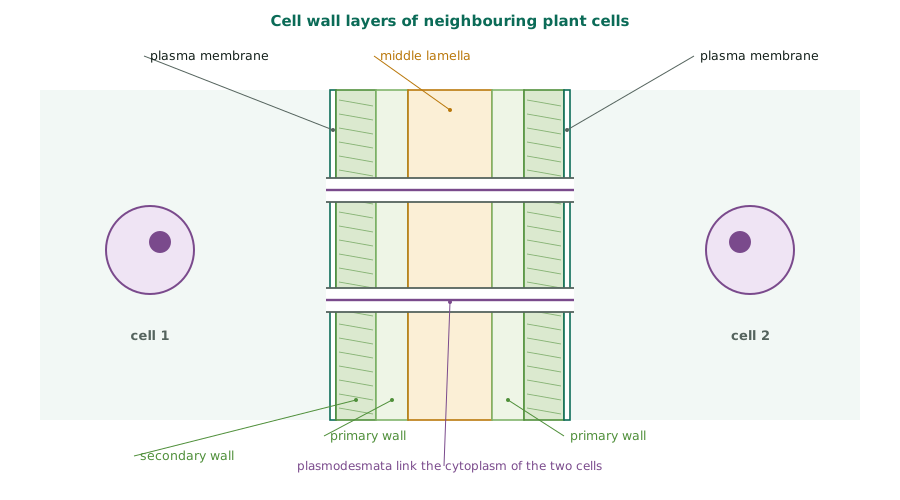
- Primary wall: secreted first, by young cells, and laid down during cell division. It is permeable, relatively thin and flexible, made mainly of cellulose fibres laid on the middle lamella; water moves freely through its spaces.
- Middle lamella: outside the primary wall; a thin layer rich in sticky pectins (magnesium and calcium pectates) that glue adjacent cells together.
- Secondary wall: laid down between the plasma membrane and the primary wall; strong, rigid and made of several layers. Besides cellulose it contains impermeable lignin and suberin; lignin holds the cellulose fibres in a rigid matrix and gives extra support.
- Plasmodesmata connect the cytoplasm of adjacent cells through pores in the wall.
Functions of the wall: protection and support; allows turgidity to build up as water enters; prevents the cell bursting when turgid; controls and limits cell growth; forms part of the apoplast pathway; keeps the shape of the cell; holds the plant upright against gravity.
Cell junctions
Cell junctions are points of direct physical contact through which neighbouring cells interact and communicate, connecting their cytoplasm and internal chemical environment.
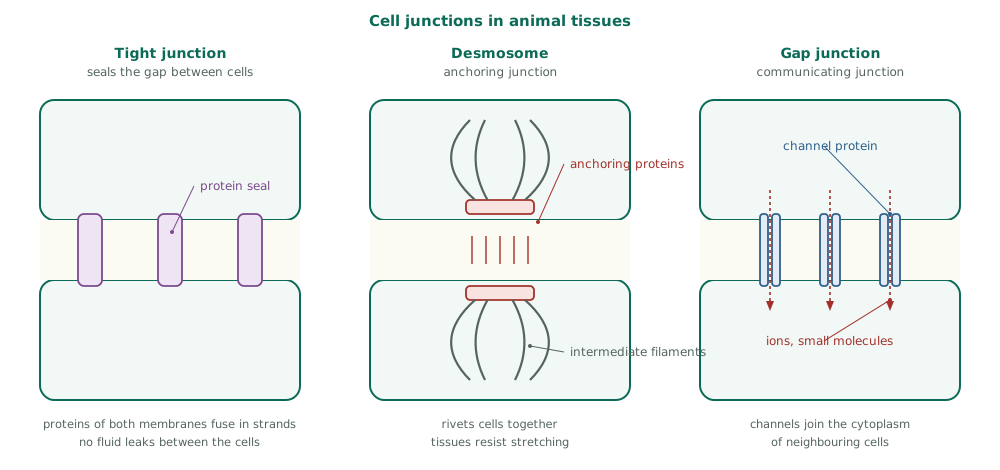
Animal cells have three types:
- Tight junctions: specific proteins form a continuous seal around the cells, so extracellular fluid cannot leak through the space between them. Example: skin epithelium.
- Desmosomes (anchoring junctions): fasten the cytoskeletons of adjacent cells together with intermediate filaments. Example: muscle tissue.
- Gap junctions (communicating junctions): channels lined with special membrane proteins around pores, through which ions, sugars and amino acids pass; they allow exchange of signals and materials. Examples: heart muscle, animal embryos.
In plants, plasmodesmata are microscopic channels through the cell walls, lined by membrane continuous with the plasma membrane. They form living cytoplasmic connections between cells.
Extracellular matrix (ECM) of animal cells
Animal cells have no wall but have an elaborate extracellular matrix of glycoproteins and other carbohydrate-containing molecules that the cells secrete. The most abundant glycoprotein is collagen, whose strong fibres are embedded in a network of proteoglycans. Fibronectin binds collagen to integral membrane proteins.
Functions: a protective layer over the cell surface; links the cytoskeleton with the ECM; influences cell behaviour by passing on mechanical and chemical signals.
Exam tip: Match each animal junction with its job and example (tight: seal, skin epithelium; desmosome: anchors with intermediate filaments, muscle; gap: channels, heart muscle and embryos). Remember that the middle lamella is pectin and that lignin and suberin are in the secondary wall.
Deshapriya Senevirathne. B.Sc. (Hons) Biology Special, University of Peradeniya — graduated with a class pass. All the content and lessons in A/L Biology on Paadama are reviewed by Deshapriya Senevirathne, and the lessons are taught by him.