Subcellular components: nucleus to chloroplast
Unit 2 · Chemical and Cellular Basis of Life
Structure and functions of the nucleus, ribosomes, endoplasmic reticulum, Golgi apparatus, lysosomes, peroxisomes, mitochondria and chloroplasts.
Organelles (subcellular components) are the specialised, membrane-bound parts suspended in the cytosol of a eukaryotic cell.
Nucleus
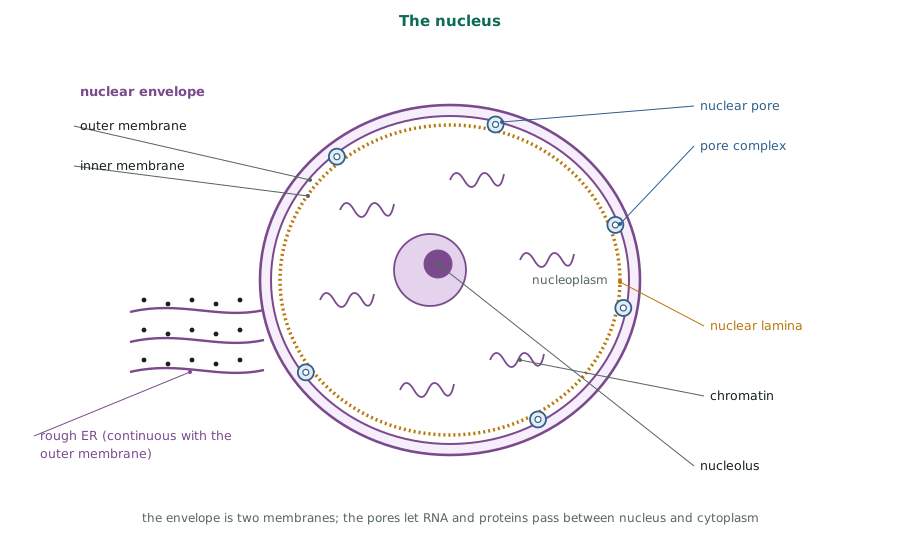
The nucleus is the most conspicuous organelle, with an average diameter of 5 µm, and holds most of the cell's genes.
- Nuclear envelope: two membranes (outer and inner) separated by a space of 20-40 nm, perforated by nuclear pores with pore complexes that control what enters and leaves. The nuclear lamina, a layer of protein filaments, lies on the inside.
- Nucleoplasm (nuclear matrix): protein filaments through the interior, in which the chromatin and nucleolus are embedded.
- Nucleolus: densely stained granules and fibres next to the chromatin.
- Chromatin: a diffuse DNA-protein complex in a non-dividing cell, which condenses into thread-like chromosomes at cell division. The number is fixed for a species: 46 in a human somatic cell.
- Functions: controls all cell activities; makes DNA for new nuclei during cell division; the nucleolus makes rRNA and ribosome subunits; mRNA and tRNA are made from DNA information; stores and passes on hereditary information.
Ribosomes
Ribosomes are the sites of protein synthesis. Each has a large and a small subunit made of rRNA and protein.
- 70S ribosomes: free in the prokaryotic cytoplasm, in the mitochondrial matrix and in the chloroplast stroma.
- 80S ribosomes: eukaryotes only; either free in the cytoplasm or bound to the surface of the rough ER.
Endoplasmic reticulum (ER)
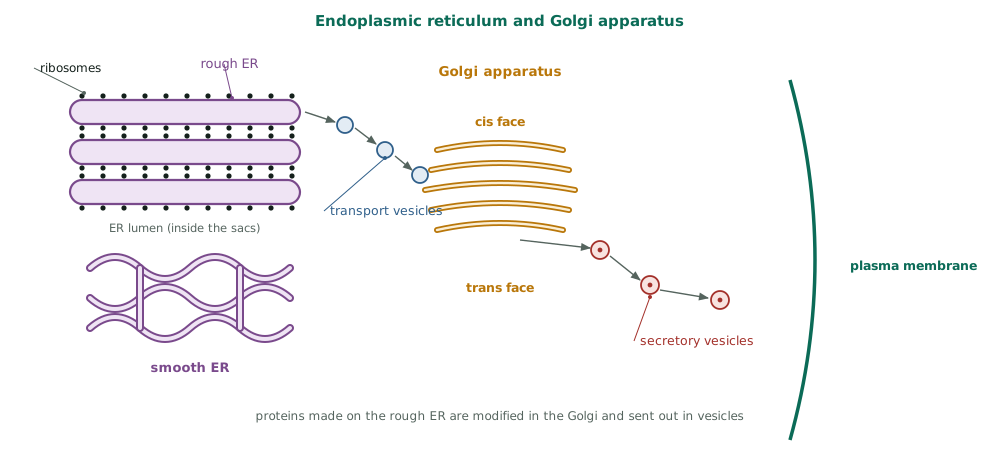
The ER is a network of flattened or tubular sacs (cisternae) of internal membrane. It separates the ER lumen from the cytosol and is continuous with the outer membrane of the nuclear envelope. There are two forms:
- Rough ER (RER): flattened sacs with ribosomes on the outer surface; the proteins they make enter the lumen. Functions: transports proteins made by the bound ribosomes; makes glycoproteins; produces transport vesicles; makes membrane phospholipids. It grows its own membrane by adding phospholipids, proteins and carbohydrates, so it is called the membrane factory.
- Smooth ER (SER): a tubular network without ribosomes, with membrane-bound enzymes. Functions: synthesises lipids (oils, steroids, phospholipids); carbohydrate metabolism; forms transport vesicles; detoxification; stores Ca²⁺.
Golgi apparatus
The Golgi apparatus is a stack of flattened sacs (cisternae). The cis face, near the ER, receives vesicles from the ER; the trans face buds off secretory vesicles. It is abundant in secretory cells. Functions: collects, modifies, sorts (packages) and dispatches materials such as proteins and membrane lipids; makes the non-cellulose components of the cell wall (e.g. pectin); produces lysosomes.
Lysosomes
Lysosomes are single-membrane vesicles for digestion. They contain hydrolytic enzymes that break down carbohydrates, lipids, proteins and nucleic acids. Functions: digest food taken in by phagocytosis; remove waste from the cell by exocytosis; digest worn-out organelles; cause cell death by autolysis.
Peroxisomes
Peroxisomes are single-membrane vesicles with oxidative enzymes, found in plant and animal cells. They break down hydrogen peroxide (H₂O₂). Functions: detoxification of peroxides and, in plants, photorespiration. Glyoxysomes are specialised peroxisomes in the fat-storing tissues of plants, which convert fatty acids into sugars.
Mitochondria
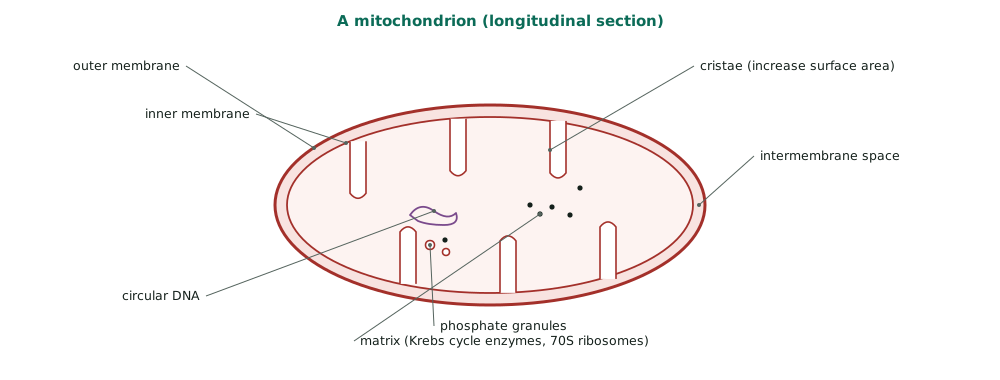
Mitochondria are among the most abundant organelles; they are elongated with two membranes. The outer membrane is smooth; the inner is folded into cristae, which increase its surface area. Between the membranes is the intermembrane space; the matrix inside contains 70S ribosomes, circular (mitochondrial) DNA, phosphate granules and enzymes. Krebs cycle enzymes are in the matrix; the cristae carry the proteins and enzymes of the electron transport chain and oxidative phosphorylation. Functions: ATP synthesis by aerobic respiration, and a role in photorespiration.
Chloroplast
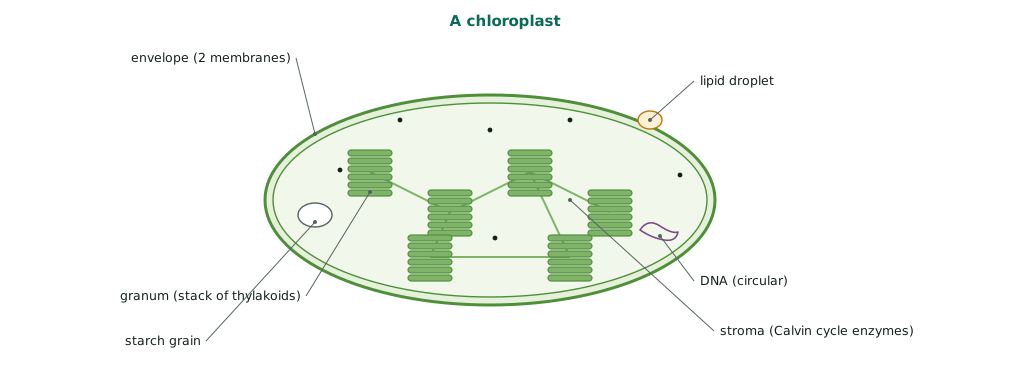
Chloroplasts occur in plants and some protists and are shaped like a biconvex lens. Two smooth membranes are separated by a very narrow intermembrane space. Inside are flattened, interconnected sacs called thylakoids, which carry pigment complexes called photosystems. Stacks of thylakoids are grana, joined by intergranal lamellae. The fluid around them is the stroma, which contains circular DNA, 70S ribosomes, many enzymes, starch grains and lipid droplets. Function: photosynthesis.
Exam tip: Learn the double-membrane organelles (nucleus, mitochondria, chloroplast) separately from the single-membrane ones (lysosome, peroxisome, vacuole). Do not say the Golgi makes glycoproteins: here the RER makes them and the Golgi modifies, sorts and dispatches. Peroxisome detoxification involves H₂O₂; glyoxysomes convert fatty acids to sugars.
Deshapriya Senevirathne. B.Sc. (Hons) Biology Special, University of Peradeniya — graduated with a class pass. All the content and lessons in A/L Biology on Paadama are reviewed by Deshapriya Senevirathne, and the lessons are taught by him.