The cell cycle and mitosis
Unit 2 · Chemical and Cellular Basis of Life
Interphase and the mitotic phase, the stages of mitosis, cytokinesis in animals and plants, control of the cell cycle and cancer.
The cell cycle
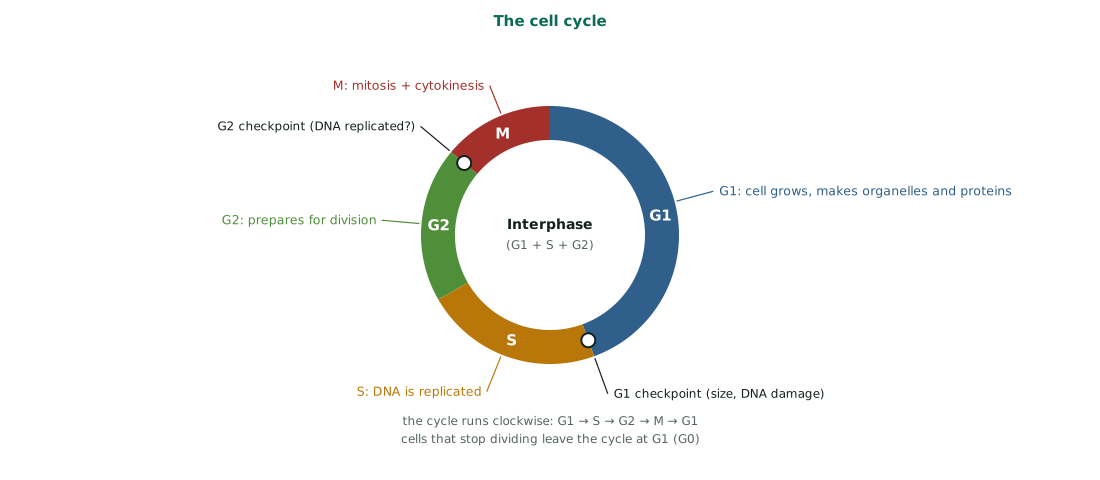
The cell cycle is the series of events from one cell division to the next.
Interphase (about 90% of the cycle) is the period of growth and preparation:
- G1 (first gap): the cell grows, makes proteins and organelles, and carries out its normal functions. Cells that no longer divide (nerve cells) stay in G0.
- S (synthesis): DNA is replicated. Each chromosome now consists of two identical sister chromatids joined at the centromere. The centrioles are also copied.
- G2 (second gap): further growth; the cell makes the proteins needed for division and checks the replicated DNA.
The M phase consists of mitosis (division of the nucleus) and cytokinesis (division of the cytoplasm).
Stages of mitosis
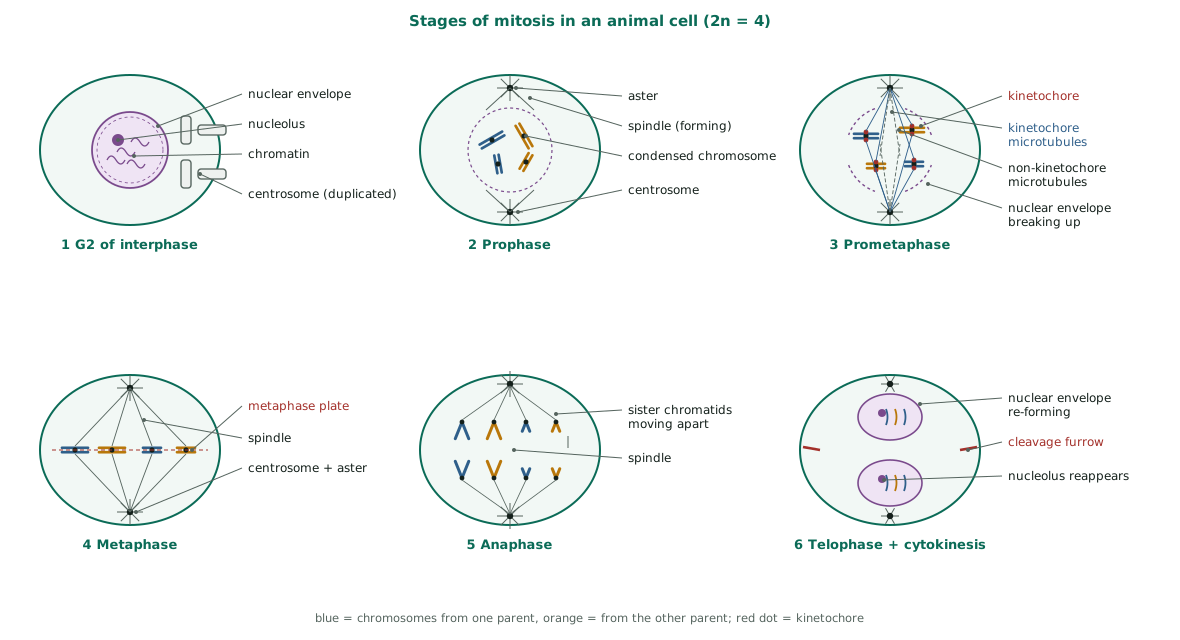
- Prophase. Chromatin condenses, so chromosomes become visible as two sister chromatids. The nucleolus disappears. The centrioles move to opposite poles and spindle microtubules form. The nuclear envelope breaks into fragments at the end of prophase.
- Metaphase. Spindle fibres attach to the kinetochore at the centromere of each chromosome, and the chromosomes line up at the equator (metaphase plate).
- Anaphase. The centromeres split and the spindle shortens, pulling the sister chromatids (now chromosomes) to opposite poles. The chromatids appear V-shaped, with the centromere leading. This needs ATP.
- Telophase. Chromosomes reach the poles and decondense. The spindle disappears, a new nuclear envelope forms around each set, and nucleoli reappear.
Cytokinesis
- Animal cells: a ring of actin and myosin filaments contracts and pinches the membrane inwards, producing a cleavage furrow that divides the cell in two.
- Plant cells: Golgi vesicles carrying wall materials fuse at the equator to form a cell plate, which develops into a new cell wall and middle lamella between the daughter cells.
Importance of mitosis
The two daughter cells are genetically identical to the parent (barring mutation) and to each other, with the same chromosome number. Mitosis is the basis of growth, repair of tissue, replacement of cells (skin, gut lining, blood) and asexual reproduction (vegetative propagation, budding in yeast and Hydra). Meristems of plants divide by mitosis.
Control of the cell cycle and cancer
The cycle is regulated at checkpoints: at G1 (is the cell large enough and the DNA undamaged?), at G2 (is DNA fully replicated?) and in metaphase (are all chromosomes attached to the spindle?). The signals are proteins called cyclins, which activate cyclin-dependent kinases (CDKs). Growth factors stimulate division.
Mutations in genes that control the cycle (proto-oncogenes and tumour-suppressor genes such as p53) can make a cell divide uncontrolled, forming a tumour. A benign tumour stays in one place; a malignant tumour (cancer) invades neighbouring tissue and spreads through the blood or lymph (metastasis). Mutagens such as UV light, tobacco smoke and some viruses increase the risk.
Deshapriya Senevirathne. B.Sc. (Hons) Biology Special, University of Peradeniya — graduated with a class pass. All the content and lessons in A/L Biology on Paadama are reviewed by Deshapriya Senevirathne, and the lessons are taught by him.