Carbohydrates
Unit 2 · Chemical and Cellular Basis of Life
Monosaccharides, disaccharides and polysaccharides: classification, the main polysaccharides (starch, glycogen, cellulose, inulin, pectin, hemicellulose, chitin) and their functions.
Carbohydrates in general
Carbohydrates are the most abundant group of organic compounds on Earth. They contain carbon, hydrogen and oxygen, with hydrogen and oxygen in the ratio 2:1 (as in water), so the general formula is Cx(H₂O)y. There are three groups: monosaccharides, disaccharides and polysaccharides. "Sugars" means the mono- and disaccharides.
Monosaccharides
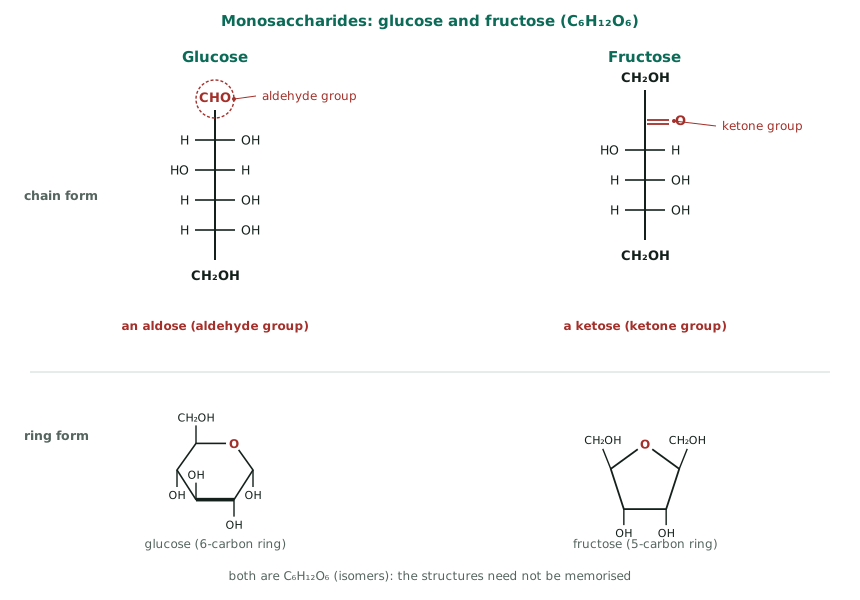
Monosaccharides have the formula (CH₂O)n with 3 to 7 carbon atoms. All are reducing sugars, dissolve in water and form crystals. They are named by the number of carbons:
| Carbons | Name | Examples |
|---|---|---|
| 3 | Triose | glyceraldehyde (phosphoglyceraldehyde is a triose derivative) |
| 4 | Tetrose | erythrose (rare in nature) |
| 5 | Pentose | ribose, deoxyribose, ribulose (RuBP is a ribulose derivative) |
| 6 | Hexose | glucose, fructose, galactose |
They can also be classified by the carbonyl group: aldoses (glucose, galactose) and ketoses (fructose). Some monosaccharides form rings in water. The structural formulae are not required to be memorised.
Disaccharides
Two monosaccharides join by a glycosidic bond in a condensation reaction, which removes a molecule of water (an OH from one unit and an H from the other).
- glucose + glucose → maltose
- glucose + fructose → sucrose
- glucose + galactose → lactose
Maltose and lactose are reducing sugars; sucrose is non-reducing.
Polysaccharides
Polysaccharides are macromolecules and biological polymers made of hundreds to thousands of monosaccharide units. Unlike sugars they do not crystallise, are insoluble in water and are not sweet. They can be grouped:
- by function: storage (starch, glycogen) and structural (cellulose, hemicellulose, pectin);
- by shape: linear (cellulose, amylose) and branched (glycogen, amylopectin, hemicellulose).
| Polysaccharide | Monomer | Function |
|---|---|---|
| Starch | glucose | stored in plants |
| Glycogen | glucose | stored in animals and fungi |
| Cellulose | glucose | component of the cell wall |
| Inulin | fructose | stored in Dahlia tubers |
| Pectin | galacturonic acid | component of the middle lamella of the plant cell wall |
| Hemicellulose | pentoses and hexoses | component of plant cell walls |
| Chitin (contains nitrogen) | glucosamine | fungal cell walls and the exoskeleton of arthropods |
Functions of carbohydrates
- Monosaccharides: a source of energy; building units of di- and polysaccharides; components of nucleotides (DNA and RNA).
- Disaccharides: lactose is the sugar stored in milk; sucrose is transported in the phloem and stored in sugar cane.
- Polysaccharides: storage: starch (plants and green algae), glycogen (animals and fungi), inulin (Dahlia tubers); structural: cellulose (walls of plants and green algae), pectin (middle lamella), hemicellulose (plant walls), chitin (fungal walls, arthropod exoskeleton).
Exam tip: The table of polysaccharides (monomer and function) is the most testable part. Remember that glycogen is stored in animals and fungi, inulin is a fructose polymer, and sucrose is the non-reducing disaccharide. Detailed ring structures and tests are not part of this section.
Deshapriya Senevirathne. B.Sc. (Hons) Biology Special, University of Peradeniya — graduated with a class pass. All the content and lessons in A/L Biology on Paadama are reviewed by Deshapriya Senevirathne, and the lessons are taught by him.