The Calvin cycle, photorespiration, C4 plants and limiting factors
Unit 2 · Chemical and Cellular Basis of Life
The three steps of the Calvin cycle, Rubisco and photorespiration, the C4 pathway and Kranz anatomy, C3 and C4 compared, and the factors that limit photosynthesis.
The Calvin cycle
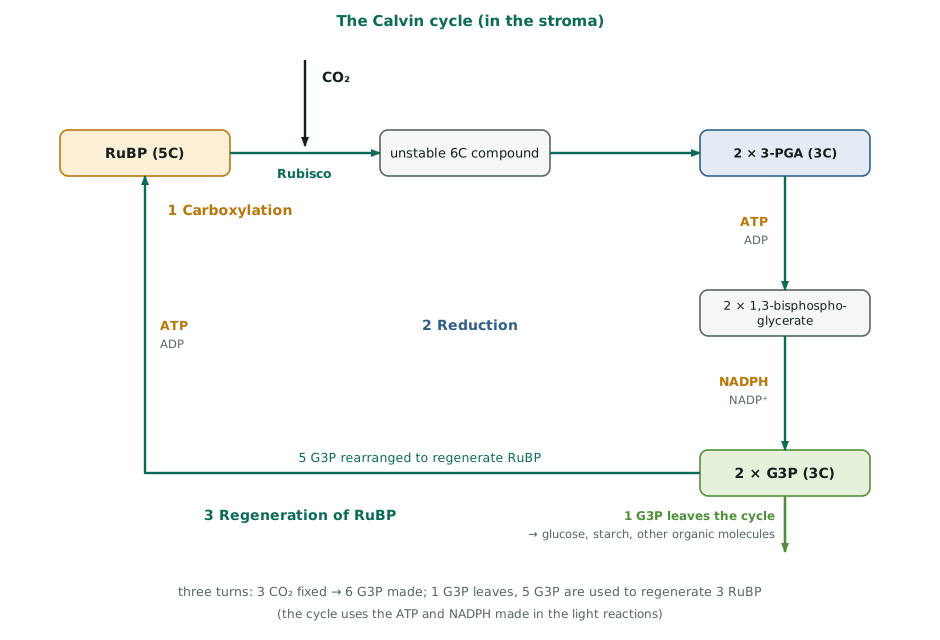
The Calvin cycle takes place in the stroma. It is an enzyme-catalysed, anabolic cycle, discovered by Calvin, that uses the ATP and NADPH from the light reaction to reduce CO₂. Its product is glyceraldehyde 3-phosphate (G3P), and the cycle must turn three times for the net synthesis of one G3P. It has three steps.
- Carboxylation (carbon fixation). The CO₂ acceptor is RuBP (5 carbons) and the enzyme is RuBP carboxylase-oxygenase, or Rubisco, which is present in large amounts in the stroma. The first product is an unstable 6-carbon molecule that splits at once into two 3-phosphoglycerate (3-PGA) molecules, the first stable product. 3-PGA takes a phosphate from ATP and becomes 1,3-bisphosphoglycerate.
- Reduction. 1,3-bisphosphoglycerate is reduced step by step to G3P, using NADPH and ATP. G3P is the starting material for making carbohydrate such as glucose.
- Regeneration of RuBP. A complex series of reactions, using ATP, makes RuBP again. G3P is then used to make glucose.
Photorespiration
Rubisco can catalyse two reactions, a carboxylase one and an oxygenase one. In the oxygenase reaction it uses the same substrate, RuBP, with O₂ at the same active site. CO₂ and O₂ are therefore competitive substrates: CO₂ inhibits the oxygenase reaction, and O₂ inhibits the carboxylase reaction.
- The oxygenase reaction gives one 3-PGA and one 2-carbon compound. The 2-carbon compound leaves the chloroplast and is processed in peroxisomes and mitochondria. (You do not need the details of this pathway.)
- Photorespiration yields no energy. Every time O₂ is used instead of CO₂, the output of 3-PGA falls by more than 50%. There is also a net loss of CO₂, so net carbon gain and productivity fall.
C4 plants
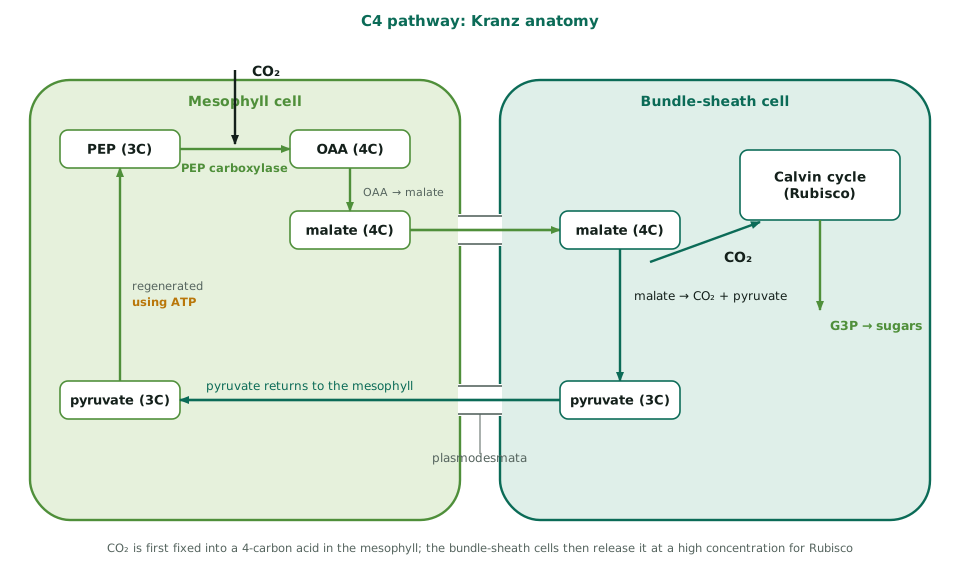
On hot, dry days the stomata close to save water. The O₂ from the light reaction builds up and the CO₂:O₂ ratio falls, which favours photorespiration. The C4 pathway concentrates CO₂ around Rubisco.
Kranz anatomy. C4 leaves have two distinct cell types, mesophyll cells and bundle-sheath cells. Bundle-sheath cells surround the veins, and mesophyll cells surround them. In C4 plants the bundle-sheath cells are larger, have more organelles and are linked to the mesophyll cells by many plasmodesmata.
The pathway:
- In a mesophyll cell, PEP (phosphoenolpyruvate, 3C) takes up CO₂, catalysed by PEP carboxylase, to give oxaloacetate (OAA, 4C).
- OAA changes to malate, a more stable C4 compound, which diffuses into the bundle-sheath cell.
- A decarboxylating enzyme breaks malate into CO₂ and pyruvate (3C). Rubisco fixes the CO₂ again, so the Calvin cycle is confined to the bundle-sheath cells.
- Pyruvate diffuses back to the mesophyll cell, where PEP is regenerated using a phosphate from ATP hydrolysis.
PEP carboxylase is more efficient than Rubisco and has no affinity for O₂.
Chloroplast dimorphism. Mesophyll chloroplasts are rich in grana, fairly large and suited to the light reaction. Bundle-sheath chloroplasts have few or no grana and have PSI only (no PSII), so their extra ATP comes from cyclic electron flow.
Significance of C4:
- Rubisco is kept apart from O₂, so photorespiration falls and CO₂ fixation stays efficient even when CO₂ is low.
- In hot, dry climates the stomata must close and CO₂ is scarce; concentrating CO₂ in the bundle sheath keeps photosynthesis efficient.
- Higher water-use efficiency.
- Rubisco works at high CO₂ in the bundle sheath, so less of it is needed, which gives higher nitrogen-use efficiency.
| Feature | C3 | C4 |
|---|---|---|
| Examples | Wheat, rice, barley | Maize, sugarcane, grasses |
| CO₂ fixation | Once | Twice (mesophyll, then bundle sheath) |
| CO₂ acceptor | 5C RuBP | 3C PEP (mesophyll); 5C RuBP (bundle sheath) |
| Enzyme | Rubisco | PEP carboxylase (mesophyll); Rubisco (bundle sheath) |
| First product | 3C 3-PGA | 4C OAA |
| Leaf anatomy | Bundle sheath, if present, is not green; photosynthesis is in the mesophyll | Kranz anatomy; photosynthesis in mesophyll and bundle sheath |
| Productivity | Generally low | Generally high |
Factors affecting photosynthesis
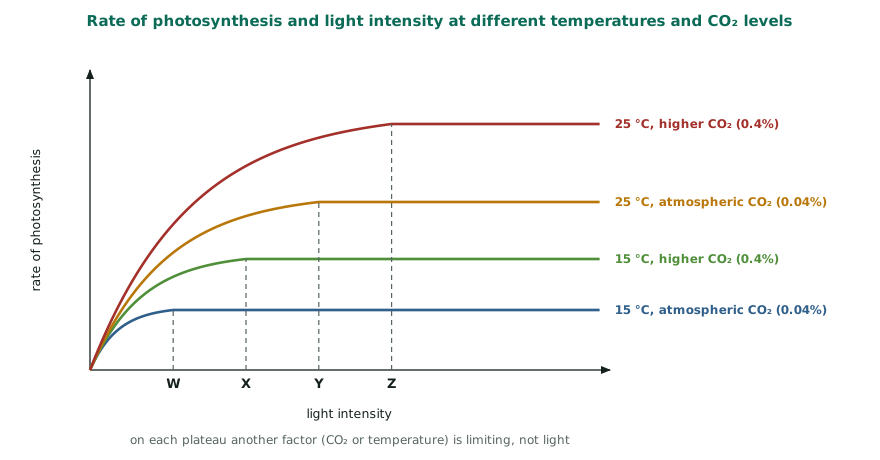
The factors are light intensity, CO₂ concentration, temperature, water, pollutants and inhibitors. Blackman's principle of limiting factors says that when a process is affected by more than one factor, its rate is set by the factor at the lowest level.
- Light intensity. The rate rises with light intensity until another factor becomes limiting. The graph shows four curves, at 15 °C and 25 °C, each with atmospheric CO₂ (0.04%) and with relatively high CO₂ (0.4%); each levels off at its own plateau (W, X, Y, Z). At very high intensity the rate falls because chlorophyll can be bleached. Plants adapted to strong light have a thick cuticle and leaves with epidermal hairs.
- CO₂ concentration. Under normal conditions this is the main limiting factor. For example, tomatoes are grown in greenhouses with raised CO₂.
Exam tip: Use the names 3-PGA and G3P (not GP and TP). For a limiting-factor graph, say which factor limits the flat part of each curve by comparing the curves that share the same other conditions.
Deshapriya Senevirathne. B.Sc. (Hons) Biology Special, University of Peradeniya — graduated with a class pass. All the content and lessons in A/L Biology on Paadama are reviewed by Deshapriya Senevirathne, and the lessons are taught by him.