Arthropods and echinoderms
Unit 3 · Evolution and Diversity of Organisms
The features of Arthropoda (chelicerates, crustaceans, myriapods and insects, with insect orders and metamorphosis) and of Echinodermata with the water vascular system.
Phylum Arthropoda
Arthropods are the most successful animal phylum: more than a million named species (about 80% of all known animals), found in the sea, fresh water, on land and in the air.
Features
- Jointed appendages (legs, antennae, mouthparts), from which the name comes (Greek arthron, joint; pous, foot).
- A hard exoskeleton of chitin (often hardened with protein and in crustaceans with calcium carbonate). It protects, prevents water loss and supports the muscles, but cannot grow, so the animal must moult (ecdysis) to grow.
- Segmented body, with segments fused into regions called tagmata (head, thorax and abdomen, or cephalothorax and abdomen).
- A haemocoel (a cavity containing blood, haemolymph) with an open circulatory system and a dorsal tubular heart; the coelom is reduced.
- A complete gut, a ventral nerve cord with a dorsal brain, and often well-developed sense organs (compound eyes, antennae).
- Gas exchange by gills (aquatic), tracheae or book lungs (terrestrial).
- Sexes are usually separate, with internal fertilisation in land forms.
| Subphylum | Features | Examples |
|---|---|---|
| Chelicerata | Two tagmata (cephalothorax and abdomen); no antennae; chelicerae (fangs or pincers) and pedipalps; four pairs of walking legs | Arachnida: spiders, scorpions, ticks, mites. Horseshoe crabs (marine) |
| Crustacea | Two tagmata or three; two pairs of antennae; biramous (two-branched) appendages; mostly aquatic with gills; a calcified exoskeleton and nauplius larva | Crabs, prawns, lobsters, shrimps, barnacles, water fleas, woodlice (the only terrestrial crustaceans) |
| Myriapoda | A head and a long trunk of many similar segments with legs; one pair of antennae; tracheae | Chilopoda (centipedes): one pair of legs per segment, carnivorous, venomous; Diplopoda (millipedes): two pairs per segment, herbivorous |
| Hexapoda (Insecta) | Three tagmata (head, thorax, abdomen); three pairs of legs on the thorax; one pair of antennae; usually two pairs of wings | Beetles, flies, butterflies, bees, ants |
Class Insecta
Insects are the largest group of animals, with more than a million named species. They were the first animals to fly. Their success is due to the small size, the waxy exoskeleton, the tracheal system, flight, and complete metamorphosis.
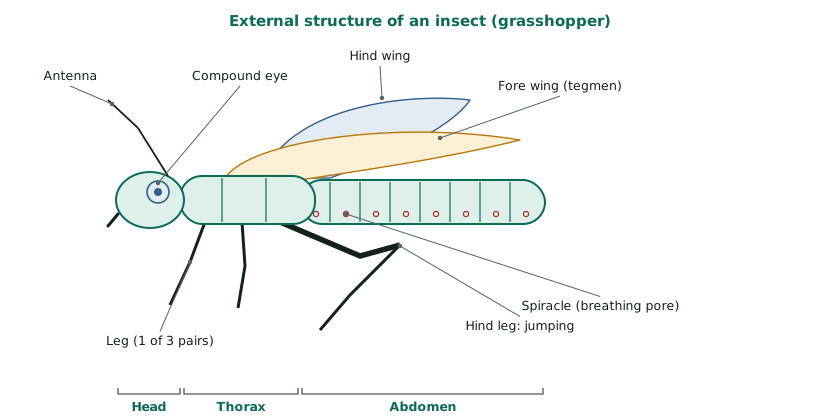
- Head: one pair of antennae (for smell and touch), a pair of compound eyes, simple eyes (ocelli) and mouthparts adapted to feeding (chewing in a grasshopper, sucking in a butterfly, piercing-sucking in a mosquito).
- Thorax: three segments with three pairs of legs and, in most, two pairs of wings (the second pair is reduced to halteres in flies; the forewings are hardened as elytra in beetles).
- Abdomen: eleven segments or fewer, with the spiracles, the reproductive organs and, in females, an ovipositor.
- Tracheal system: air tubes (tracheae) open to the outside at spiracles and branch to supply oxygen directly to the cells, so the blood does not carry oxygen. Malpighian tubules remove nitrogenous waste (as uric acid) from the haemolymph and pass it into the gut, saving water.
Metamorphosis
- Complete metamorphosis (holometabolous): egg, larva (caterpillar, grub or maggot), pupa, adult. The larva and adult differ in form and food, so they do not compete (butterflies, flies, beetles, bees, mosquitoes).
- Incomplete metamorphosis (hemimetabolous): egg, nymph (a small version of the adult without wings), adult, with several moults (grasshoppers, dragonflies, bugs, termites, cockroaches).
| Order | Features | Examples |
|---|---|---|
| Orthoptera | Chewing mouthparts; leathery forewings; large hind legs for jumping; incomplete metamorphosis | Grasshoppers, crickets |
| Lepidoptera | Wings covered in scales; siphon-like proboscis; complete metamorphosis | Butterflies, moths, the silkworm |
| Diptera | One pair of wings (the hind pair are halteres); complete metamorphosis | House flies, mosquitoes (Aedes, Anopheles, Culex) |
| Coleoptera | Hardened forewings (elytra) that cover the hindwings; complete metamorphosis; the largest order | Beetles, weevils, ladybirds |
| Hymenoptera | Two pairs of membranous wings; narrow "waist"; sting in females; many are social | Bees, wasps, ants |
| Hemiptera | Piercing-sucking mouthparts; incomplete metamorphosis | Bugs, aphids, cicadas; the rice bug and the brown planthopper |
| Odonata | Two pairs of large wings, large eyes; aquatic nymphs; incomplete metamorphosis | Dragonflies, damselflies |
Importance of insects. Beneficial: pollinators (bees, butterflies), honey and wax (bees), silk (silkworm), natural pest control, decomposers and food for other animals. Harmful: crop pests (rice planthoppers, stem borers, termites), pests of stored grain, and vectors of disease: Aedes aegypti and A. albopictus (dengue, which causes frequent epidemics in Sri Lanka), Anopheles (malaria), Culex (filariasis), fleas (plague) and houseflies (typhoid and dysentery).
Exam tip: To tell the arthropod groups apart quickly count the legs and antennae: arachnids have 8 legs and no antennae; insects have 6 legs and 1 pair of antennae; crustaceans have 2 pairs of antennae and usually 10 or more legs; centipedes and millipedes have many legs.
Phylum Echinodermata
About 7 000 species, all marine (sea stars, brittle stars, sea urchins, sand dollars, sea cucumbers and sea lilies), mostly living on the sea floor.
Features
- Deuterostomes (together with chordates, from which they are closely related) with a true coelom; the larvae are bilaterally symmetrical and the adults show pentamerous radial symmetry (body parts in fives), which is secondary.
- An endoskeleton of calcareous plates (ossicles) under the epidermis, often bearing spines (hence "spiny skin").
- A unique water vascular system: a network of fluid-filled canals that ends in muscular tube feet (podia), used in movement, feeding and gas exchange. Water enters through the madreporite, then passes along the stone canal to the ring canal and the radial canals in each arm, and into the tube feet with their ampullae. Contraction of the ampulla pushes water into the tube foot and extends it; suckers hold on.
- No head and no brain (a nerve ring and radial nerves); no excretory organs; gas exchange by skin gills and tube feet.
- Digestive tract with mouth on the lower (oral) surface; most are carnivores or scavengers.
- Regeneration of lost arms; separate sexes with external fertilisation.
| Class | Features | Examples |
|---|---|---|
| Asteroidea | Star shape; arms not clearly marked off from the disc; tube feet with suckers; prey on bivalves | Sea stars (starfish) |
| Ophiuroidea | Slender, flexible arms sharply set off from the disc; no suckers | Brittle stars |
| Echinoidea | No arms; rigid test with movable spines | Sea urchins, sand dollars |
| Holothuroidea | Soft, elongated, leathery body without spines; tentacles around the mouth | Sea cucumbers (the bêche-de-mer fishery of Sri Lanka) |
| Crinoidea | Feather-like arms; often stalked | Sea lilies, feather stars |
The echinoderms are important because they show the evolutionary link between invertebrates and chordates: both are deuterostomes.